Brand comparison
Artec vs Creaform: which 3D scanner brand fits your work?
Both brands turn a physical object into accurate 3D data in minutes instead of days of manual measuring. They get there in different ways, and the right one depends on what you scan, your tolerances and who will scan.
Key takeaways
- Creaform's core is blue laser triangulation with positioning targets or the C-Track optical tracker, aimed at metrology on the shop floor.
- Artec's core is target-free structured light with color texture, plus a blue-laser scanner (Point II), a hybrid blue-light scanner (Neo), desktop (Micro II) and LiDAR (Ray II, Jet) options.
- Both publish accredited accuracy: Creaform tests in ISO/IEC 17025-accredited labs, and Artec certifies each Neo and Spider II in its own accredited lab.
- Creaform runs every Creaform-branded scanner (the peel 3 uses its own Peel.OS) in Creaform.OS with Scan-to-CAD and Inspection modules; Artec runs every scanner except the Jet in Artec Studio, which includes scan-to-CAD and inspection tools.
- Neither brand wins everywhere: choose by size, surface, tolerance and who will scan, then check it on your own work.
Which should you choose: Artec or Creaform?
Choose Creaform when the job is tolerance-driven inspection or large parts on a shop floor: its blue-laser HandySCAN line, the C-Track-based MetraSCAN and HandyPROBE, and the MaxSHOT photogrammetry camera are built to hold metrology accuracy despite vibration and part movement. Choose Artec when you want fast capture without targets, full color, wireless scanners and one software package from a desktop unit to long-range LiDAR: Leo, Eva, Spider II, Micro II and Ray II share Artec Studio. The two overlap in the middle, where the Artec Point II and Neo meet the HandySCAN on accuracy. Many teams pick by part size and finish, then confirm on a demo with their own part.
Who Artec suits
- Teams that want to start scanning without targets or surface preparation on most parts.
- Design, reverse-engineering and visualization work where full color texture matters.
- Mixed-size work from small detailed parts (Spider II, Micro II) up to rooms and sites (Ray II, Jet).
- Field work where a wireless scanner with its own screen and battery, like the Leo, saves setup.
- Shops that prefer one software package, Artec Studio, across every Artec scanner they own except the Jet.
Who Creaform suits
- Quality teams that measure to tight tolerances and need accredited accuracy figures in reports.
- Shop floors with vibration, moving parts or difficult shiny and dark surfaces.
- Large parts and assemblies, with the HandySCAN MAX EVO, MetraSCAN and MaxSHOT NEXT.
- Plants that want probing and scanning on one tracker (HandyPROBE with MetraSCAN) or robot cells (R-Series).
- Engineers who want inspection and reverse engineering as dedicated Creaform Metrology Suite modules.
How do the Artec and Creaform ranges compare overall?
The table sums up each brand's range as it appears in this catalog. Every cell is worked out from the product data, which was checked against creaform3d.com and artec3d.com: the measuring technologies used, the finest stated accuracy, the largest recommended part for a handheld scanner, and which models capture color, scan without targets or run wireless. It shows where the ranges overlap and where only one brand has an answer, such as Creaform's touch probe and robot cells, or Artec's desktop scanner and LiDAR. Use it to see which brand covers your mix of parts, then compare individual models below.
| Specification | Artec | Creaform |
|---|---|---|
| Scanners we offer | 8 | 10 |
| Measuring technologies | Structured light, LiDAR and laser triangulation | Laser triangulation, structured light, optical tracking, touch probing, photogrammetry and projected infrared light |
| Finest stated accuracy, handheld | 0.020 mm (Point II) | 0.020 mm (HandySCAN EVO) |
| Finest stated accuracy, any system | 0.005 mm (Micro II) | 0.020 mm (HandySCAN EVO) |
| Largest recommended part, handheld | Up to 2 m (Eva, Point II and Leo) | Up to 15 m (HandySCAN MAX EVO) |
| Color texture | Neo, Eva, Spider II, Micro II, Leo and Ray II | Go!SCAN SPARK and peel 3 |
| No targets needed | Jet, Eva, Spider II, Micro II, Leo and Ray II | MetraSCAN 3D and HandyPROBE Next+ |
| Targets optional | Neo | Go!SCAN SPARK and peel 3 |
| Wireless operation | Neo, Jet, Leo and Ray II | HandySCAN EVO (with the Mobility Kit), HandySCAN MAX EVO (with the Mobility Kit) and HandyPROBE Next+ |
| Long-range LiDAR | Jet and Ray II | None in this catalog |
| Photogrammetry | Metrology Kit and AI Photogrammetry | MaxSHOT NEXT |
| Automated or desktop systems | Micro II | R-Series |
| Touch probing | None in this catalog | HandyPROBE Next+ |
| Software we offer | Artec Studio, Metrology Kit and AI Photogrammetry | Creaform.OS, Scan-to-CAD, Inspection, Dynamic Tracking and VXelements |
How do Artec and Creaform scanners capture a part differently?
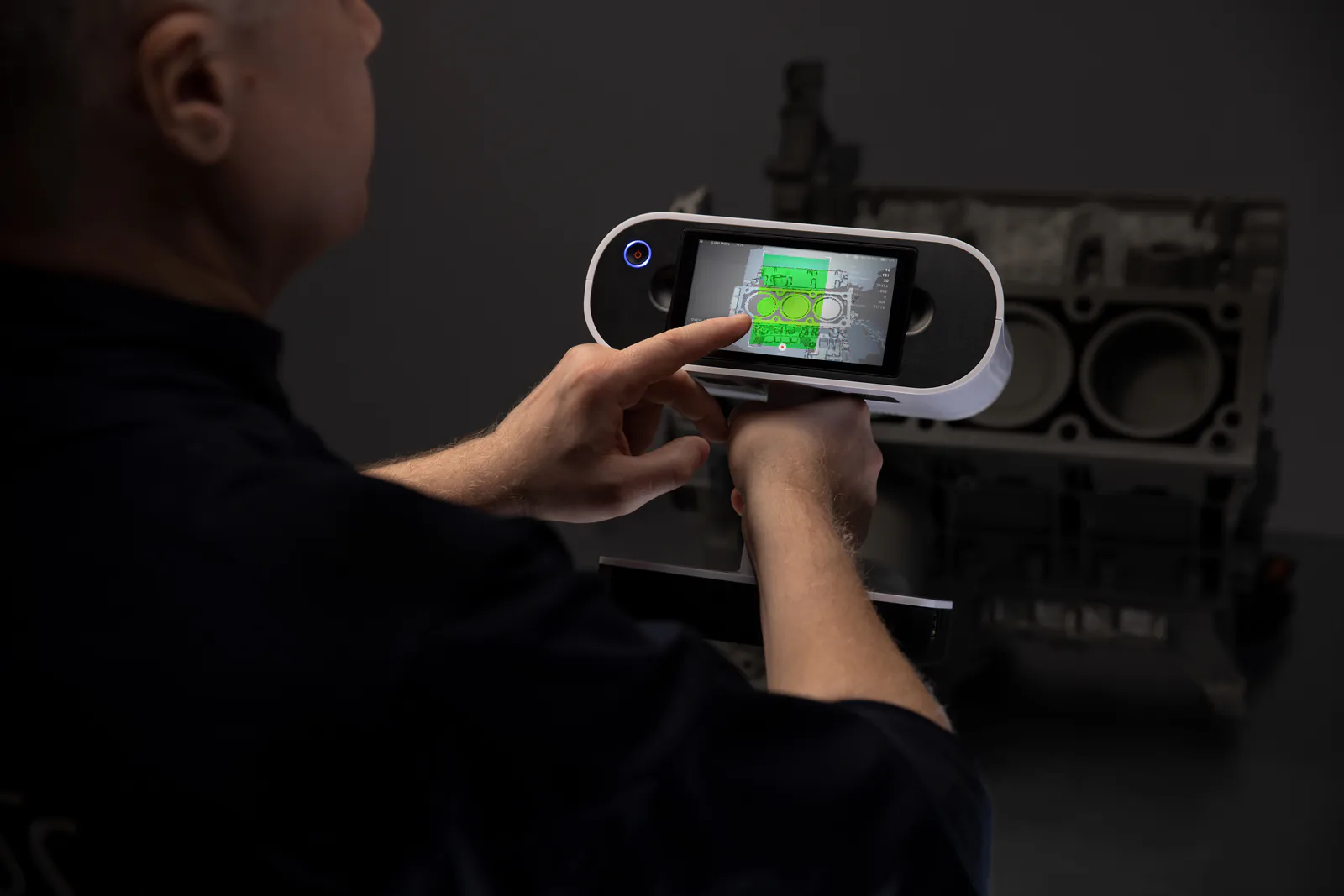
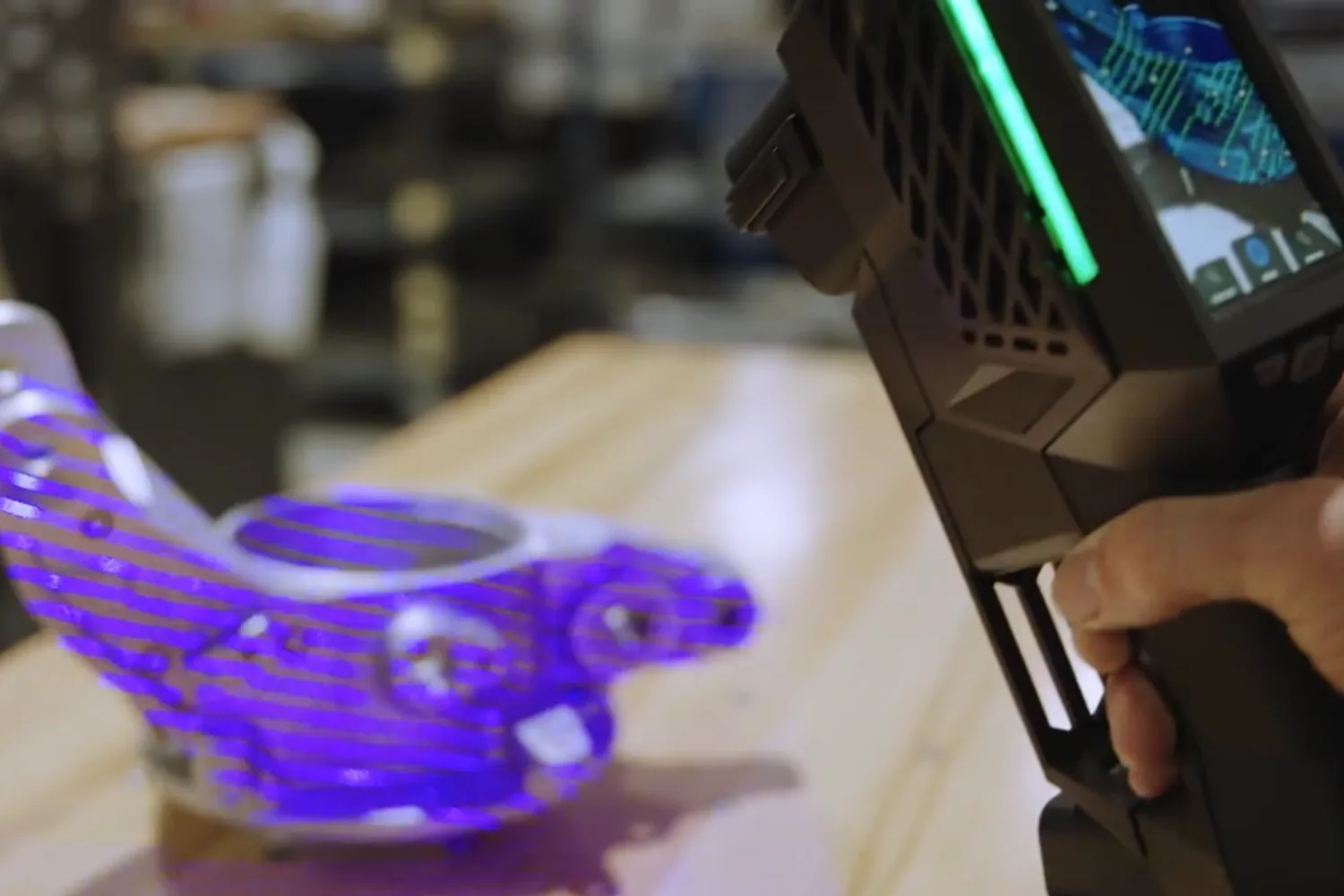
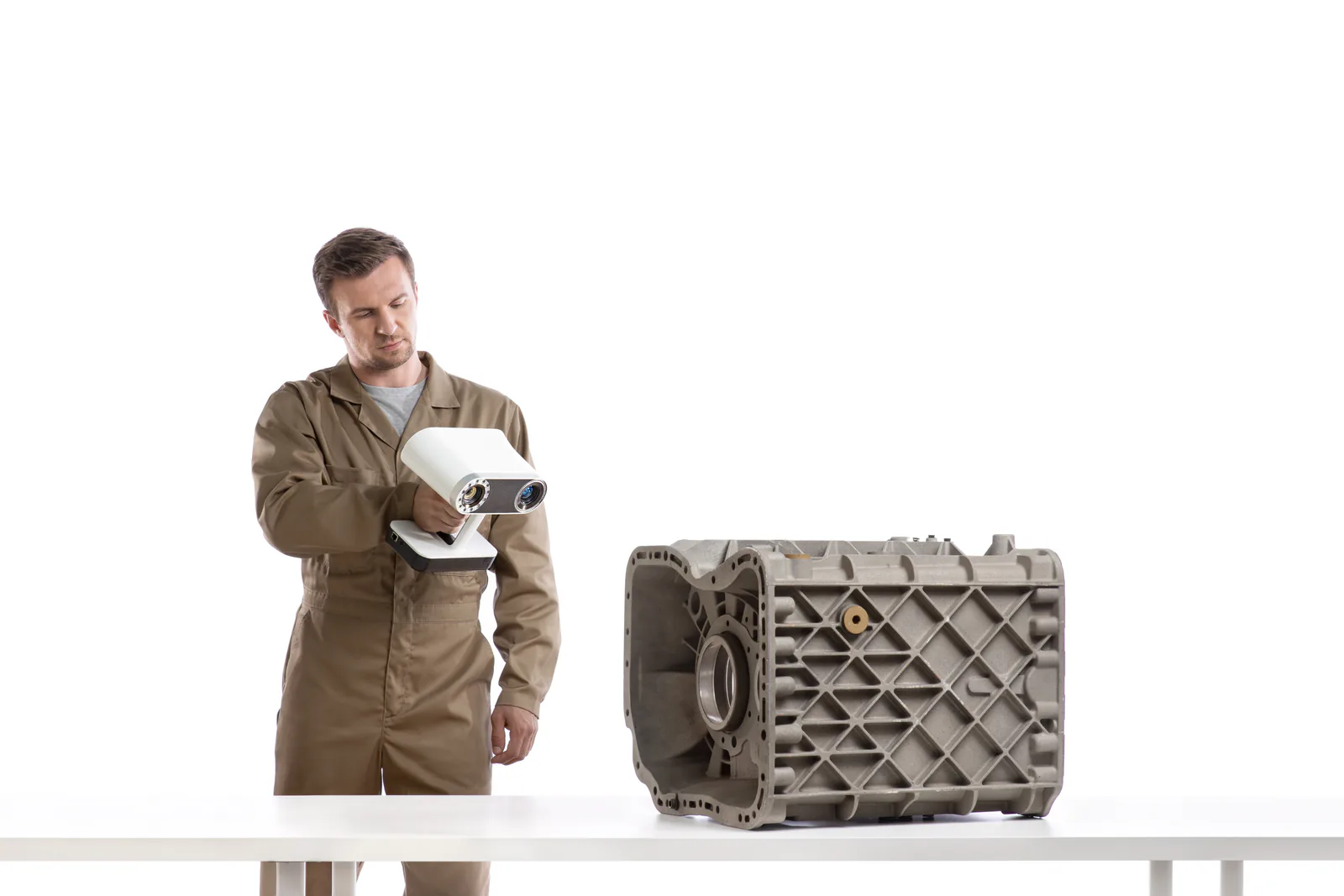
Creaform's HandySCAN, MetraSCAN and R-Series project blue laser lines and triangulate them, which works well on shiny, dark and machined surfaces. A HandySCAN positions itself from small targets stuck on or around the part; a MetraSCAN or HandyPROBE is followed by the C-Track, a dual-camera optical tracker, so the part stays clean and the setup tolerates vibration. Most Artec handhelds, such as the Leo, Eva and Spider II, project structured light and track on the part's own shape and color texture, so you start scanning without targets and get a colored model. Artec also has a target-based laser scanner, the Point II, a hybrid blue-light scanner, the Neo, that scans with or without targets, and LiDAR for rooms and sites.
Which brand is more accurate?
At the top of each range the published figures meet. The HandySCAN EVO Elite is rated at 0.020 mm and the Artec Point II at up to 0.02 mm, both handheld blue-laser scanners using targets. The Artec Micro II desktop scanner goes further on small parts, at 5 microns. The bigger difference is in the mid-range: Artec's popular structured-light scanners, the Leo and Eva, are rated at up to 0.1 mm, which suits reverse engineering, design and color work more than tight-tolerance inspection. For long parts, compare volumetric accuracy, which grows with length, and look at the photogrammetry options: Creaform's MaxSHOT NEXT and Artec's Metrology Kit both tighten it.
Which brand is easier to learn and use?
Artec's structured-light scanners have the gentlest start: no targets, color feedback, and on the Leo a built-in screen and battery with no laptop or cable. Artec Studio adds an Autopilot mode that picks processing settings for new users. Creaform's workflow asks for one more habit, placing positioning targets on HandySCAN jobs, but Creaform.OS guides the operator with live meshing, AI-driven target detection and, on the EVO Series, a touchscreen on the scanner, with AR guidance on the EVO Plus and Elite. The MetraSCAN removes targets altogether by using the C-Track. In practice both brands are learned on real parts; training is offered self-paced, online, on-site or in a classroom.
Which brand suits large parts, small parts or whole sites?
For large parts that need metrology accuracy, Creaform has the deeper bench: the HandySCAN MAX EVO for parts from 1 to 15 m, the MetraSCAN and HandyPROBE for target-free work on parts up to 10 m, and the MaxSHOT NEXT camera to hold accuracy over length. For small, detailed parts, Artec stands out with the Spider II for target-free fine detail and the Micro II desktop scanner for automated measurement of parts up to 200 × 200 × 150 mm. For rooms, plants and sites, only Artec has LiDAR in this catalog: the Ray II on a tripod and the Jet for mobile mapping.
How do Creaform.OS and Artec Studio compare?
Creaform.OS is included with every Creaform-branded scanner (the peel 3 uses its own Peel.OS) and runs acquisition for scanning, probing and photogrammetry. Analysis lives in separate modules of the Creaform Metrology Suite: Scan-to-CAD for reverse engineering, Inspection for GD&T reports, plus Automation and Dynamic Tracking. Artec Studio is one program for capture, processing, scan-to-CAD primitives and auto-surfacing, CAD comparison maps and AI Photogrammetry, and it runs every Artec scanner except the Jet, from the Micro II desktop unit to the Ray II LiDAR. Both export standard meshes and CAD formats, and both hand off to tools such as SOLIDWORKS and Geomagic Design X. If your team lives in a metrology report workflow, Creaform's Inspection module fits; if one program across mixed hardware matters, Artec Studio fits.
Can one team use both brands?
Yes. The scanners export open mesh formats such as STL, OBJ and PLY, so data from a Creaform laser scanner and an Artec structured-light scanner can meet in the same CAD or inspection package. One workable split is a Creaform HandySCAN or MetraSCAN for tolerance checks on the shop floor and an Artec Leo or Eva for fast, colored capture of large or organic shapes in design and marketing. To compare them side by side, name both products in your request, and we will tell you whether both can be shown in your area.
Which models fit which need?
For each common need, the table names the Creaform and the Artec models our specialists usually put forward first. It is a starting point, not a verdict: a need such as large parts can be met by a Creaform HandySCAN MAX EVO or MetraSCAN, or by an Artec Leo paired with a Ray II, and the better choice depends on your tolerance, your surfaces and your team. Where one brand lists more models, that brand has more depth for that need, and where a cell says to ask us, that brand has no model in this catalog built for it. Follow a model name to its product page, or read the model-to-model comparison that matches your shortlist.
| Need | Lean Creaform | Lean Artec |
|---|---|---|
| Tight tolerances | MetraSCAN 3D, HandySCAN BLACK Elite | Point II, Neo |
| A floor that vibrates or a part that moves | MetraSCAN 3D, HandyPROBE Next+ | Ask us |
| Large parts and assemblies | HandySCAN MAX EVO, MetraSCAN 3D | Leo, Ray II |
| Ease of use, wireless or color | Go!SCAN SPARK | Leo, Eva, Spider II |
| Fine-detail reverse engineering | HandySCAN PRO, HandySCAN BLACK Elite | Spider II |
Which models lean each way, by need
Tight tolerances
- Lean Creaform
- MetraSCAN 3D, HandySCAN BLACK Elite
A floor that vibrates or a part that moves
- Lean Creaform
- MetraSCAN 3D, HandyPROBE Next+
- Lean Artec
- Ask us
Large parts and assemblies
- Lean Creaform
- HandySCAN MAX EVO, MetraSCAN 3D
Ease of use, wireless or color
- Lean Creaform
- Go!SCAN SPARK
Fine-detail reverse engineering
- Lean Creaform
- HandySCAN PRO, HandySCAN BLACK Elite
- Lean Artec
- Spider II
What else do buyers ask about Artec and Creaform?
Is Creaform or Artec better?
Neither is better across the board. Creaform leads where accuracy must hold on a shop floor or across a large part, with blue-laser scanners, the C-Track optical tracker and photogrammetry. Artec leads where speed, no targets, color and wireless use matter, and it covers the extremes of size with a desktop scanner and LiDAR. The best choice follows what you scan and your tolerances, so compare them on a real job before you decide.
Do Artec scanners need targets like Creaform HandySCAN scanners?
Most do not. The Leo, Eva, Spider II and Micro II track on the object's shape and texture, and the Ray II and Jet need no targets either. The Artec Point II does use retroreflective targets, and the Neo can scan with or without them. On the Creaform side, the HandySCAN line uses targets, the Go!SCAN SPARK makes them optional, and the MetraSCAN and HandyPROBE avoid them by using the C-Track tracker.
Which brand captures color?
Artec captures color texture on most of its range: the Leo, Eva, Spider II, Micro II, Neo and Ray II all record color. On the Creaform side, the Go!SCAN SPARK and peel 3 capture color, while the HandySCAN, MetraSCAN and R-Series record geometry only. If your models feed design reviews, marketing, heritage records or medical fitting, color is often worth weighting heavily; for inspection reports it rarely matters.
Can I see an Artec and a Creaform scanner on the same part?
Ask for it when you request a demo. Name both products in your request, and we will tell you whether both can be shown in your area. Describe what you need to scan and the tolerance or use you care about most, so our specialist can plan the visit. On-site demos are available in most areas; ask when you request. Where both can be shown, you compare speed, setup and results on the same job.
Are Creaform and Artec accuracy figures comparable?
Mostly, with care. Both makers quote a single-point accuracy and a volumetric accuracy that grows with distance, and both test against VDI/VDE 2634 part 3, with Creaform also citing ISO 10360 for some models. Compare the same kind of figure, check whether it assumes targets, and work out the volumetric figure for your part length. Structured-light figures for the Leo and Eva are stated as up to 0.1 mm.
See Creaform and Artec on your own work
Tell us the job that is hardest to measure today. We scan it where it is and show you the result, so you compare on your own work, not on a spec sheet. On-site demos are available in most areas; ask when you request.