Scanner comparison
Go!SCAN SPARK vs Artec Eva
Both are white-light handheld scanners that record shape and color in one pass, aimed at design, reverse engineering and visualization. The choice comes down to accuracy, weight and ecosystem.
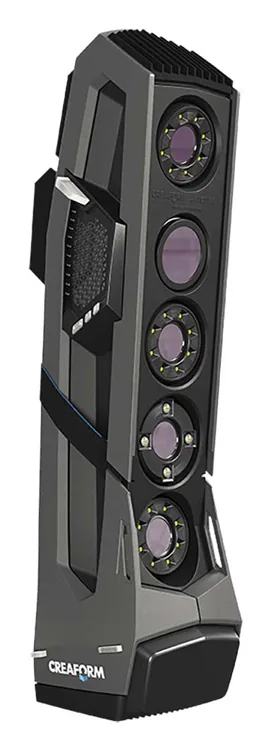
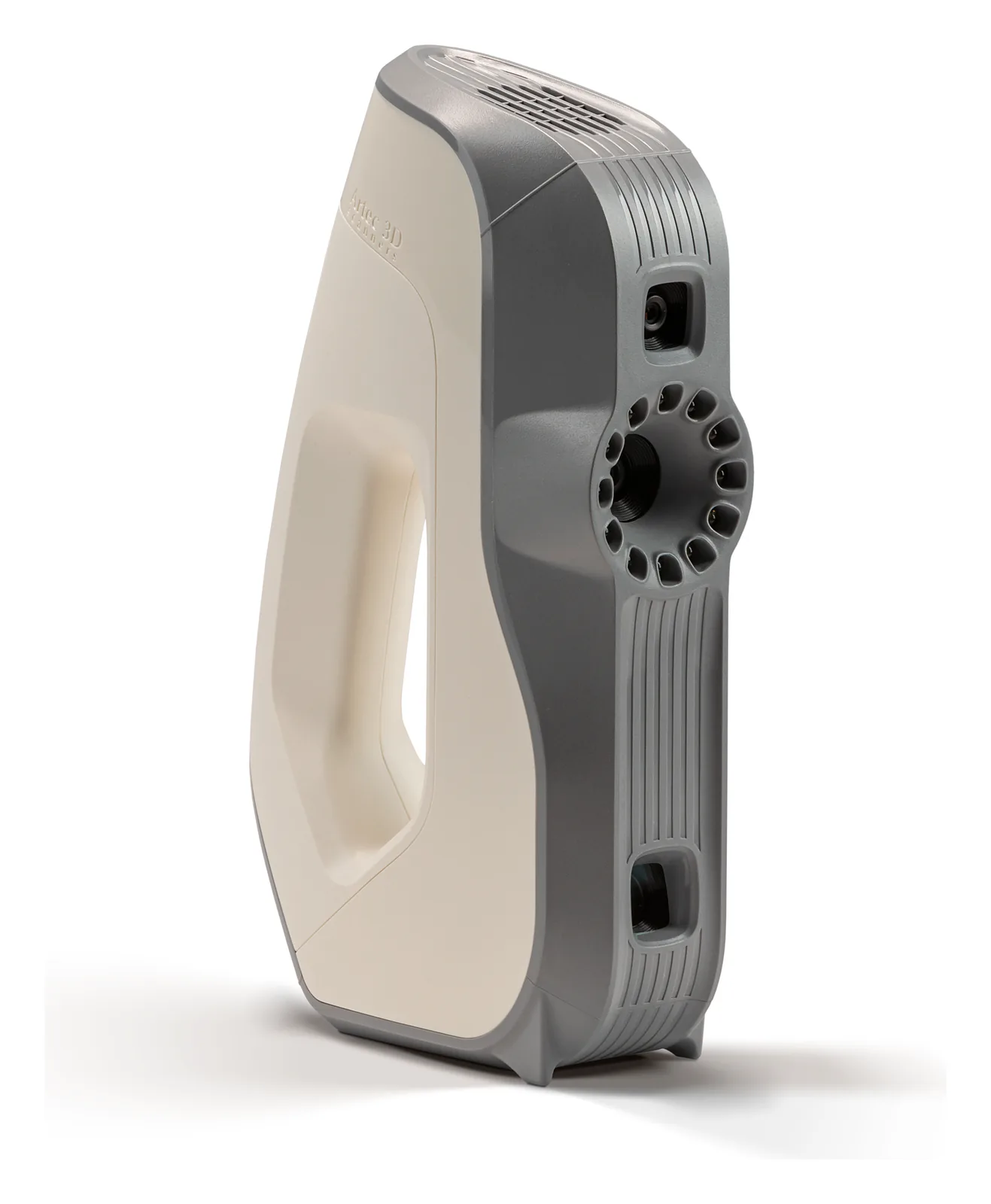
Key takeaways
- Both are handheld white-light scanners that record color texture together with geometry.
- Stated accuracy: up to 0.050 mm for the Go!SCAN SPARK and up to 0.1 mm for the Eva.
- Weight: 1.25 kg for the Go!SCAN SPARK and 0.9 kg for the Eva.
- The Eva needs no targets on most parts; the Go!SCAN makes them optional for flat or plain objects.
- The Go!SCAN runs in Creaform.OS and pairs with the MaxSHOT NEXT; the Eva runs in Artec Studio with HD mode.
Which should you choose: Go!SCAN SPARK or Artec Eva?
Choose the Go!SCAN SPARK when you want a color scanner with tighter numbers and a path into Creaform's metrology tools: it is rated at up to 0.050 mm, records 1,500,000 measurements per second, and can add a MaxSHOT NEXT camera for larger parts. Choose the Artec Eva when you want the lightest, simplest color scanner for medium objects and people: 0.9 kg, no targets or calibration, up to 0.1 mm accuracy, and a common choice for medical fitting, heritage and design work, with Artec Studio's HD mode for finer detail. Both capture color without targets on most objects, so the decision often follows the rest of your hardware.
Who the Go!SCAN SPARK suits
- Design and reverse-engineering teams that want color with the tighter accuracy of the two.
- Shops that already run Creaform hardware and want one software platform, Creaform.OS.
- Larger objects near 4 m, where a MaxSHOT NEXT camera can hold accuracy over length.
- Users who want to choose between target-free and target-based tracking per job.
Who the Artec Eva suits
- First-time scanner users who want no targets, no calibration and a light 0.9 kg scanner.
- Scanning people for orthotics, prosthetics and medical device fitting.
- Heritage, CGI and design teams that need fast color capture of medium objects.
- Teams that already own Artec scanners and want to merge data in Artec Studio.
How do the Go!SCAN SPARK and Eva specs compare?
The table lines up the published specifications of the Go!SCAN SPARK and the Eva, read from creaform3d.com and artec3d.com and never retyped. Where a scanner comes in several models, a cell shows the range across them or names each model. 'Not published' means the maker does not state that figure. Compare single-point accuracy with volumetric accuracy at your own part length, then check targets, color and wireless use against the way your team works. The verdict above explains which differences matter for which jobs.
| Specification | Go!SCAN SPARK | Artec Eva |
|---|---|---|
| Technology | White structured light | White structured light |
| Accuracy | Up to 0.050 mm | Up to 0.1 mm |
| Volumetric accuracy | 0.050 mm + 0.100 mm/m | Up to 0.1 mm + 0.3 mm/m |
| Resolution | 0.100 mm | Up to 0.2 mm (HD mode) |
| Measurement speed | 1,500,000 measurements/s | Up to 18,000,000 points/s |
| Field of view | 390 × 390 mm | 214 × 148 mm |
| Working distance | 400 mm | 0.4–1 m |
| Recommended part size | 0.1–4 m | 0.1–2 m |
| Positioning targets | Optional | Not needed |
| Color texture | Yes | Yes |
| Weight | 1.25 kg | 0.9 kg |
| Connection | 1 × USB 3.0 | 1 × USB 2.0, USB 3.0 compatible |
Specs checked:
How does the technology differ?
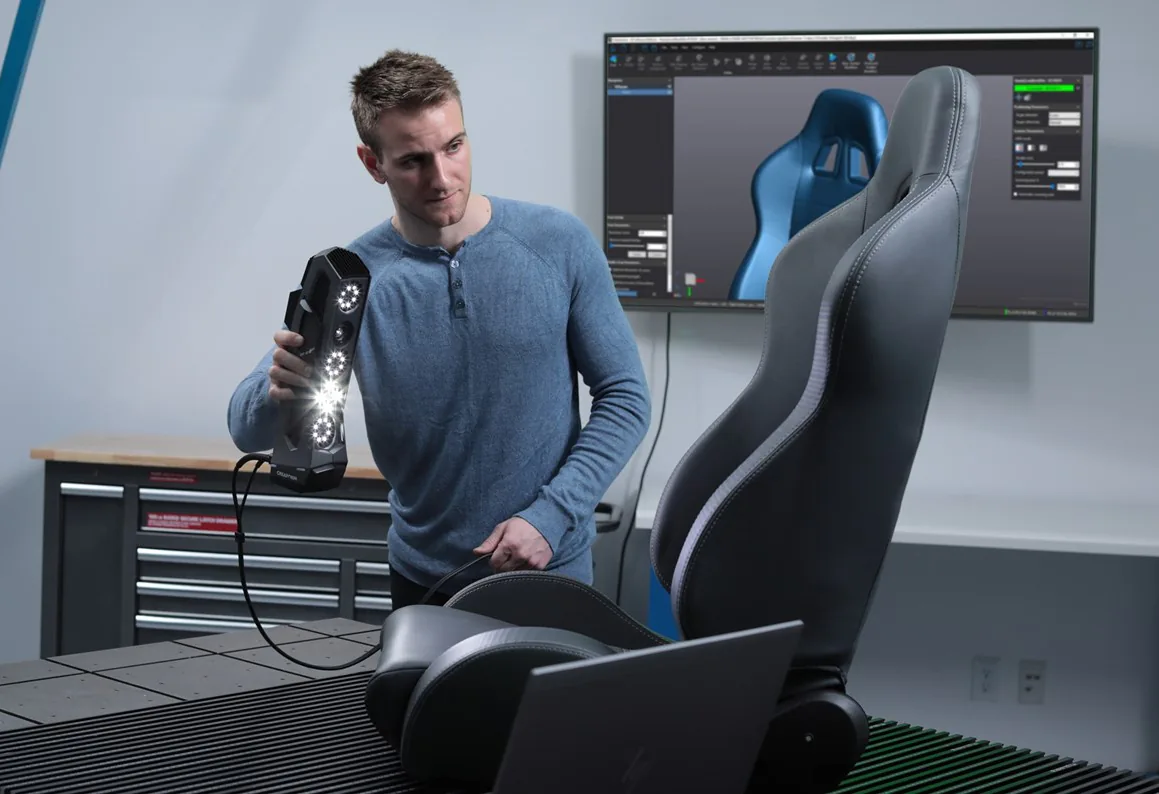
Both project white structured light and record color in the same pass as the geometry. The Go!SCAN SPARK projects 99 white light lines over a 390 × 390 mm area from a 400 mm stand-off, and positions itself from the part's geometry, its color texture, targets or a mix. The Eva uses a flash light source, works 0.4 to 1 m from the surface, and tracks on geometry and color together, with no targets or calibration before you start. The Go!SCAN records 24-bit color at 50 to 200 DPI; the Eva records 1.3 MP color texture. Both connect to a computer by USB.
Which is more accurate?
The Go!SCAN SPARK. Creaform rates it at up to 0.050 mm, with volumetric accuracy of 0.050 mm + 0.100 mm/m, which tightens to 0.050 mm + 0.015 mm/m with a MaxSHOT NEXT Elite camera on larger parts. Artec rates the Eva at up to 0.1 mm, and 0.1 mm + 0.3 mm/m over distance, with resolution up to 0.2 mm in HD mode. Neither is a tight-tolerance inspection scanner; both are built for capture where shape and color matter. If you expect to need inspection-grade figures later, Creaform's blue-laser HandySCAN line or Artec's Point II and Neo are the next step.
Which is easier to use?
Both are among the easiest scanners in either catalog. The Eva is lighter, at 0.9 kg against 1.25 kg, and needs no targets on most parts, which makes it a common first scanner and a good fit for scanning people, who must hold still for the length of the scan. Artec Studio's Autopilot mode walks new users through processing. The Go!SCAN usually needs no targets either, but Creaform advises adding a few on flat or plain objects. Creaform.OS shows the mesh live and exports ready-to-use files. If several occasional users will share the scanner, the Eva's simpler start is an advantage.
Which objects suit each scanner?
Creaform recommends the Go!SCAN SPARK for parts from 0.1 to 4 m, such as prototypes, consumer products, vehicle parts and objects for color archives. Artec places the Eva from about 10 cm up, with a sweet spot around 20 cm to 2 m: car wheels, busts, body parts and exhaust systems. Both handle freeform and organic shapes well because they track on texture as well as geometry. The Eva is the more established choice for orthotics, prosthetics and medical fitting. The Go!SCAN is the stronger choice when the same team also measures parts and wants the option of a photogrammetry frame.
What else do buyers ask about the Go!SCAN SPARK and the Artec Eva?
Which scanner suits scanning people?
The Eva is the established choice. Artec states it is safe for people and animals because it projects white light from a flash source, not a laser, and it is used for orthotics, prosthetics and medical device fitting. The Go!SCAN SPARK also uses white light, and Creaform lists medical work among its industries. With either scanner the person must hold still for the whole scan, because movement adds noise to the model.
Do I need targets with either scanner?
Usually not. The Eva tracks on geometry and color together, so you start without targets or calibration. The Go!SCAN SPARK can position itself from geometry, color texture, targets or a mix of the three; Creaform advises adding targets to objects with little shape or texture, such as a large flat panel, to keep tracking reliable.
Which one is better for reverse engineering?
For parts that will be rebuilt in CAD with tight fits, the Go!SCAN SPARK, because of its tighter stated accuracy and Creaform's Scan-to-CAD module. For larger organic shapes where the overall form matters more than hundredths of a millimeter, the Eva is quick and simple, and Artec Studio fits primitives and auto-surfaces the mesh. Both export STL, OBJ and other standard mesh formats.
Do both capture color texture?
Yes. The Go!SCAN SPARK records 24-bit color texture at 50 to 200 DPI, and the Eva records 1.3 MP color texture, both in the same pass as the geometry. Color helps tracking on smooth objects, and it makes the model useful for design reviews, presentations, product documentation and digital archives.
See the Go!SCAN SPARK and the Artec Eva on your own work
Tell us the job that is hardest to measure today. We scan it where it is and show you the result, so you compare on your own work, not on a spec sheet. On-site demos are available in most areas; ask when you request.