Scanner comparison
MaxSHOT NEXT vs Artec Ray II
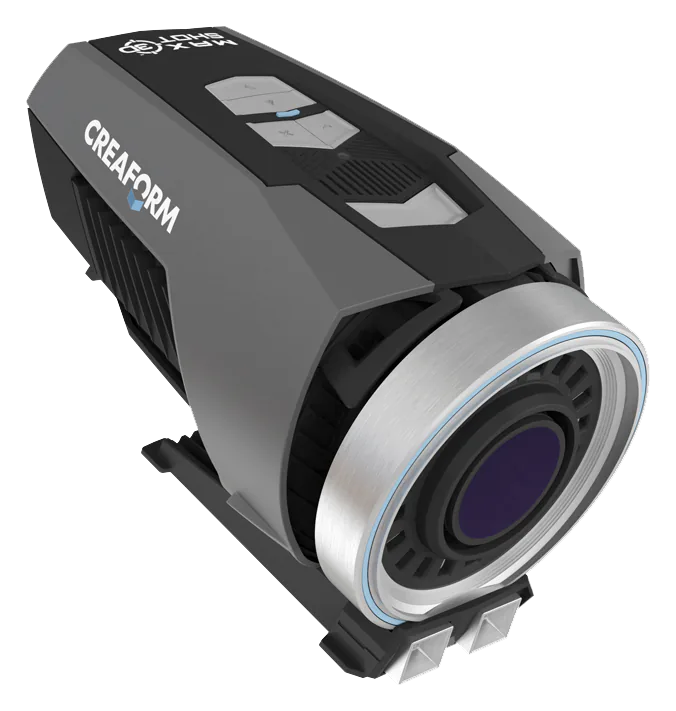
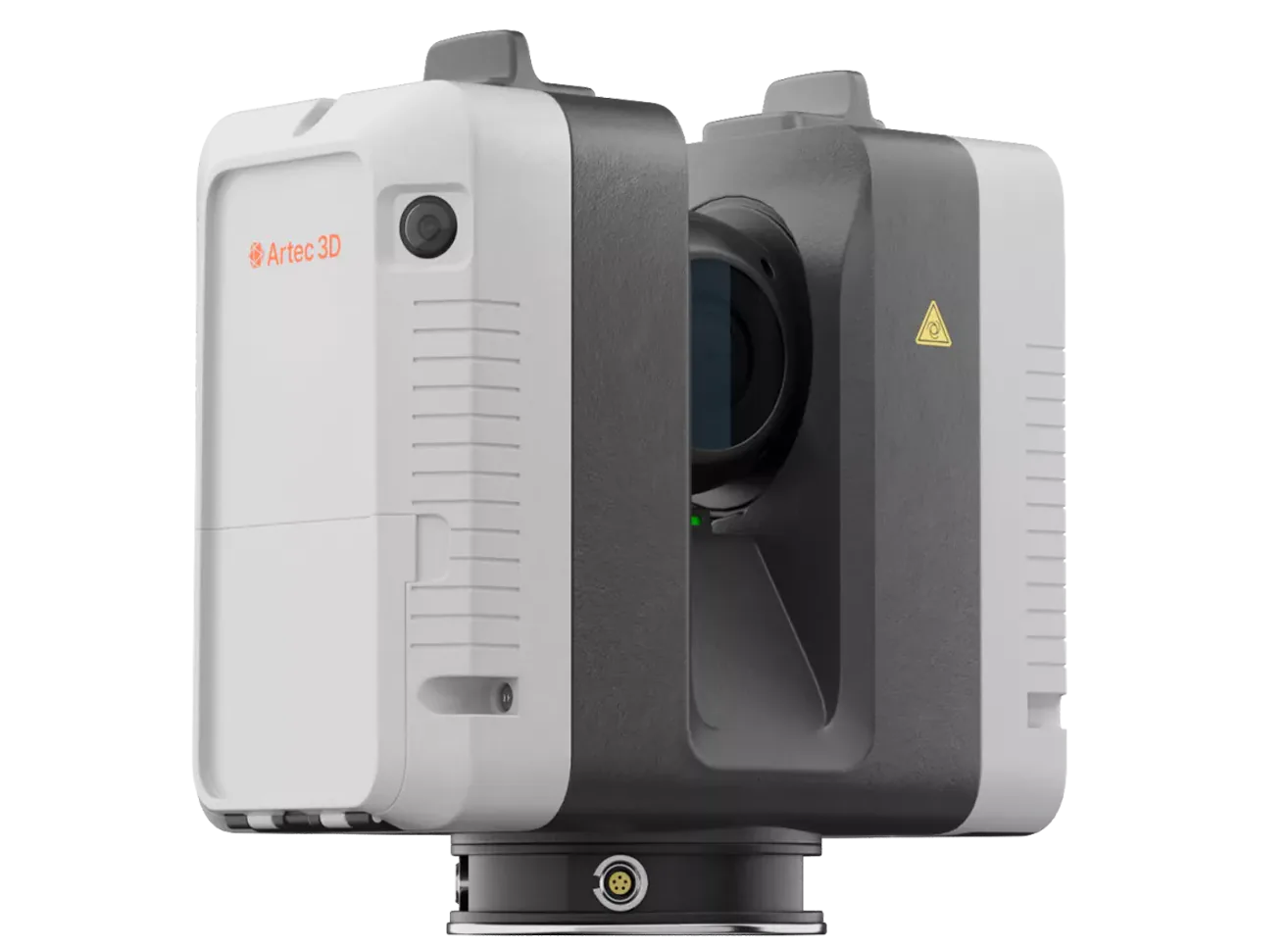
Both deal with objects too big for a handheld scanner alone, but they solve different problems. The MaxSHOT NEXT holds metrology accuracy across a large part; the Ray II captures whole objects and spaces from far away.
Key takeaways
- The MaxSHOT NEXT is a photogrammetry camera that measures a reference frame; it does not capture surfaces by itself.
- The Artec Ray II is a tripod LiDAR scanner that captures surfaces and color from 0.5 to 130 m.
- Accuracy: 0.015 to 0.025 mm/m volumetric for the MaxSHOT; 1.9 mm at 10 m for the Ray II.
- The MaxSHOT pairs with a HandySCAN, Go!SCAN, MetraSCAN or HandyPROBE; the Ray II pairs with handheld Artec scanners such as the Leo.
- Pick the MaxSHOT for tolerance-driven work on large parts and the Ray II for digital twins of big objects and sites.
Which should you choose: MaxSHOT NEXT or Artec Ray II?
Choose the MaxSHOT NEXT when a large part, from 2 to 10 m, must be measured to metrology accuracy: the camera fixes a reference frame at 0.015 mm/m (NEXT Elite) or 0.025 mm/m (NEXT), and your Creaform scanner or probe then works inside it without building up error. Choose the Artec Ray II when you need to capture big objects and spaces quickly, aircraft, vehicles, factory floors or buildings, from 0.5 to 130 m away in full color: it is rated at 1.9 mm at 10 m and needs no targets. The MaxSHOT is a precision add-on that needs a scanner; the Ray II is a stand-alone capture tool.
Who the MaxSHOT NEXT suits
- Metrology on large parts from 2 to 10 m, such as tooling, molds and aerospace structures.
- Teams that already own a Creaform HandySCAN, Go!SCAN, MetraSCAN or HandyPROBE.
- Jobs where volumetric accuracy over length decides whether the part passes.
- Plants that also want direct point measurement and reports from the photogrammetry data.
Who the Artec Ray II suits
- Digital twins of factory floors, facilities and buildings.
- Large objects such as aircraft, vehicles, wind turbine blades and ship propellers, in color.
- Forensic and heritage teams documenting whole scenes or sites.
- Artec users who want long-range capture to merge with Leo scans in Artec Studio.
How do the MaxSHOT NEXT and Ray II specs compare?
The table lines up the published specifications of the MaxSHOT NEXT and the Ray II, read from creaform3d.com and artec3d.com and never retyped. Where a scanner comes in several models, a cell shows the range across them or names each model. 'Not published' means the maker does not state that figure. Compare single-point accuracy with volumetric accuracy at your own part length, then check targets, color and wireless use against the way your team works. The verdict above explains which differences matter for which jobs.
| Specification | MaxSHOT NEXT | Artec Ray II |
|---|---|---|
| Technology | Photogrammetry | LiDAR, time of flight with Waveform Digitizing |
| Product class | Portable photogrammetry camera (optical coordinate measuring system) | Tripod-mounted long-range LiDAR scanner |
| Stated accuracy | 0.015–0.025 mm/m (by model) | 1.9 mm @ 10 m; 2.9 mm @ 20 m; 5.3 mm @ 40 m |
| Part size or range | 2–10 m | 0.5–130 m |
| Color texture | No | Yes |
| Weight | 0.79 kg | 5.35 kg (nominal, without batteries) |
| Dimensions | 104 × 180 × 115 mm | 120 × 240 × 230 mm |
| Laser class | 2M | Class 1, 1550 nm (invisible) |
| Operating temperature | 5–40 °C | −5 °C to +40 °C |
| Accuracy test | Based on VDI/VDE 2634 part 1 | Not published |
Specs checked:
How do photogrammetry and LiDAR differ here?
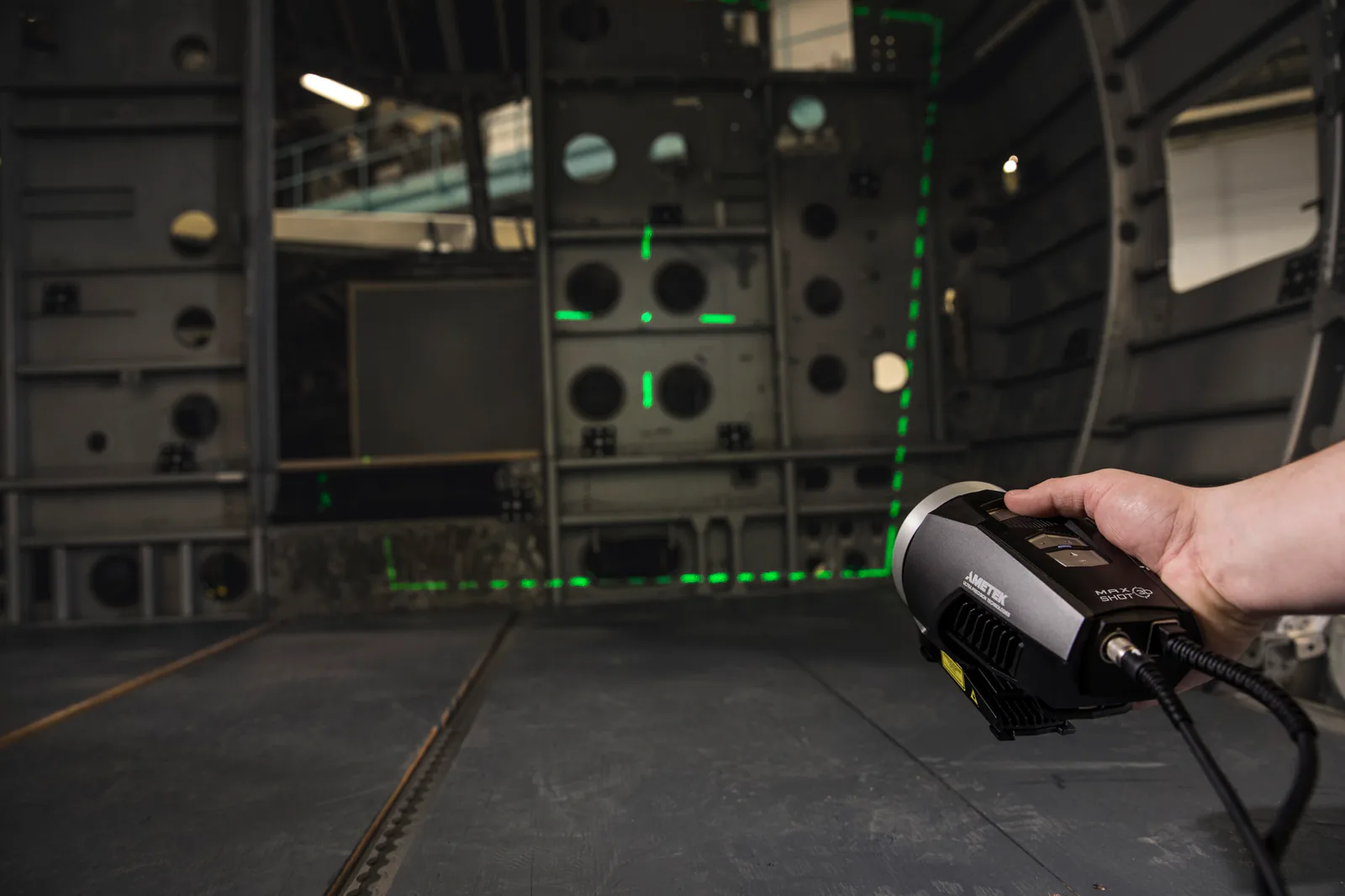
The MaxSHOT NEXT is a handheld photogrammetry camera. You place targets on and around a large part, take pictures from many angles, and the software computes the 3D positions of those reference points very precisely. That frame of reference is then loaded into a Creaform scanner or probe session, so the scanner's small errors cannot build up across the part. The Artec Ray II is a tripod-mounted LiDAR scanner: it measures distance by time of flight, sweeping 360° × 300° at up to 2,000,000 points per second, and records 36 MP HDR color. It captures the surfaces themselves, with no targets.
Which is more accurate?
For a large part, the MaxSHOT NEXT setup, by a wide margin. Creaform rates the camera at 0.025 mm/m (NEXT) or 0.015 mm/m (NEXT Elite), and with a HandySCAN BLACK or EVO the combined system reaches 0.020 mm + 0.015 mm/m. Artec rates the Ray II at 1.9 mm at 10 m, 2.9 mm at 20 m and 5.3 mm at 40 m, with 1.0 mm + 10 ppm range accuracy. That is excellent for a long-range scanner and fine for layouts, digital twins and visual inspection, but it is a different class from photogrammetry-backed metrology. Match the tool to your tolerance.
Which is faster and easier to use?
The Ray II is the faster way to capture a big scene: set the tripod, start the scan from the Artec Remote app, and move to the next position, with each setup pre-aligned by the scanner's onboard visual inertial system. A full dome at 3 mm resolution takes 1 min 42 s without texture. The MaxSHOT workflow takes more preparation, placing targets and scale references and shooting the part, but the camera's laser-projected frame and go/no-go feedback catch bad pictures before the final calculation. Creaform describes the camera as quick to set up and run.
Which jobs suit each tool?
Use the MaxSHOT NEXT for large tooling, molds, fixtures, aerospace structures, transportation equipment and heavy machinery from 2 to 10 m, where the scan must pass an inspection or feed a precise CAD model. It works with the HandySCAN BLACK, EVO and PRO, the Go!SCAN SPARK, the MetraSCAN and the HandyPROBE. Use the Ray II for aircraft, wind turbine blades, ship propellers, vehicles, factory floors, facilities, heritage sites and forensic scenes, from 0.5 to 130 m, where you need the whole object or space in color. The Ray II merges with Leo scans in Artec Studio for close-up detail.
What else do buyers ask about the MaxSHOT NEXT and the Artec Ray II?
Does the MaxSHOT NEXT replace a 3D scanner?
No. It measures an accurate frame of reference points across a large part but does not record the surface. You pair it with a Creaform scanner or probe, which then works inside that frame. The combination keeps the scanner's detail and replaces its length-dependent error with the camera's much smaller one.
Can the Artec Ray II be used for inspection?
Yes, at its accuracy class. Ray II scans can be compared with CAD in Artec Studio or sent to Geomagic Control X for reports, and Artec cites aircraft and large-part inspection. Its figures, 1.9 mm at 10 m, suit checks of large structures, layouts and deformation rather than tight machining tolerances. Keep the scanner close to surfaces with the tightest tolerances.
Does the Ray II need targets?
No. The Ray II aligns each new tripod position automatically with its onboard visual inertial system, so no targets are placed in the scene. The MaxSHOT NEXT, by contrast, works entirely from reference points placed on and around the part, which is the source of its precision.
Is there an Artec equivalent to the MaxSHOT?
Yes: the Artec Metrology Kit, a photogrammetry add-on for Artec Studio. Used as a reference, it brings the Artec Point II's volumetric accuracy to 0.015 mm + 0.015 mm/m. Like the MaxSHOT, it measures a target frame for a scanner to work inside, rather than capturing surfaces itself.
See the MaxSHOT NEXT and the Artec Ray II on your own work
Tell us the job that is hardest to measure today. We scan it where it is and show you the result, so you compare on your own work, not on a spec sheet. On-site demos are available in most areas; ask when you request.