Scanner comparison
HandySCAN EVO vs Artec Leo
One is a metrology-grade laser scanner for inspection; the other is a self-contained wireless scanner for fast, colored capture of medium and large objects. Here is how to tell which job you have.
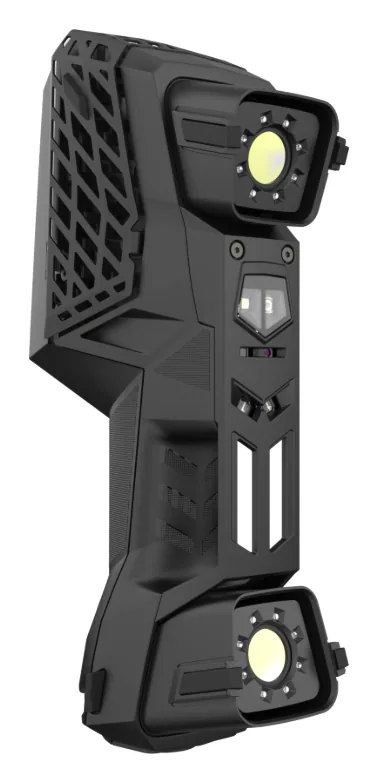
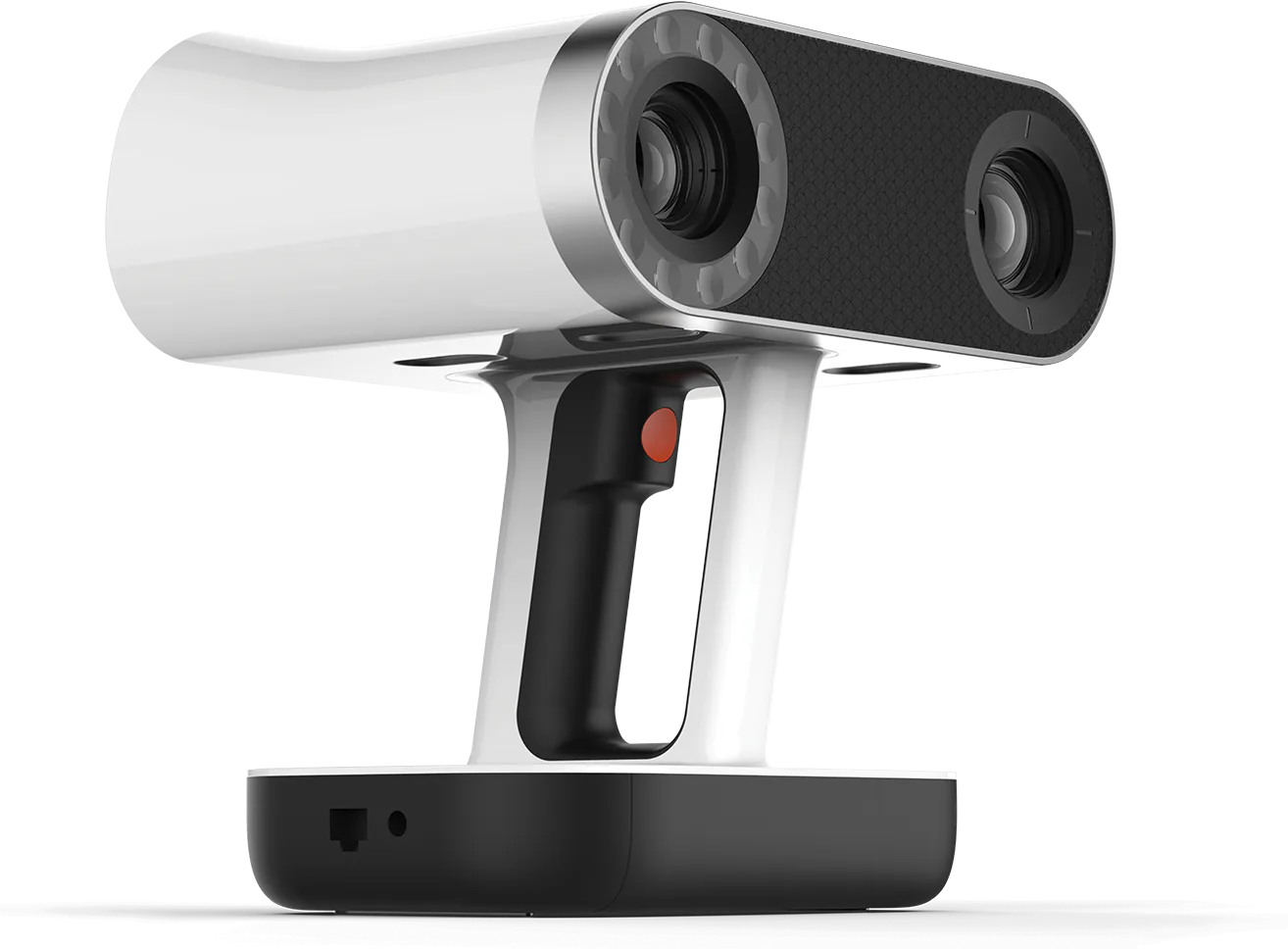
Key takeaways
- Accuracy: the HandySCAN EVO is rated at 0.020 to 0.025 mm by model; the Artec Leo at up to 0.1 mm.
- Setup: the EVO uses positioning targets on or around the part; the Leo tracks on shape and texture with no targets.
- Freedom: the Leo is fully wireless with an onboard screen and processor; the EVO has a 4.3-inch touchscreen and goes wireless with the Mobility Kit.
- Output: the Leo records color texture; the EVO records geometry only, and its Plus and Elite add a 12 MP AR camera.
- Fit: the EVO suits inspection and quality control; the Leo suits reverse engineering, design and field capture of larger objects.
Which should you choose: HandySCAN EVO or Artec Leo?
Choose the HandySCAN EVO when you check parts against CAD to tight tolerances: it is rated at 0.025 mm (EVO, EVO Plus) or 0.020 mm (EVO Elite), tested in Creaform's ISO/IEC 17025-accredited lab, and it handles shiny and dark metal with little preparation. Choose the Artec Leo when you need to capture medium to large objects quickly, in color, without targets, cables or a laptop: it runs on its own battery and processor and is rated at up to 0.1 mm. The EVO gives you the tighter numbers; the Leo gives you the faster, freer capture. Parts with both needs often justify a look at both on a demo.
Who the HandySCAN EVO suits
- Quality and inspection teams that compare production parts with CAD and report deviations.
- Shops scanning shiny, dark or machined metal without wanting to powder or spray it.
- Users who want CAD-based auto-alignment for repeat inspections of the same part.
- Teams that need certified figures: Creaform's lab tests the EVO Elite based on ISO 10360.
Who the Artec Leo suits
- Reverse-engineering and design teams that want a full-color model of medium to large objects.
- Field and on-site work with no power outlet or space for a laptop.
- Objects that cannot carry targets, such as finished surfaces, artwork or people.
- Teams with several occasional operators, since there are no targets or cables to manage.
How do the HandySCAN EVO and Leo specs compare?
The table lines up the published specifications of the HandySCAN EVO and the Leo, read from creaform3d.com and artec3d.com and never retyped. Where a scanner comes in several models, a cell shows the range across them or names each model. 'Not published' means the maker does not state that figure. Compare single-point accuracy with volumetric accuracy at your own part length, then check targets, color and wireless use against the way your team works. The verdict above explains which differences matter for which jobs.
| Specification | HandySCAN EVO | Artec Leo |
|---|---|---|
| Technology | Blue laser triangulation | Structured light (VCSEL) |
| Product class | Handheld metrology-grade blue-laser 3D scanner | Wireless handheld 3D scanner with onboard processing |
| Accuracy | 0.020–0.025 mm (by model) | Up to 0.1 mm |
| Volumetric accuracy | 0.020 mm + 0.040 mm/m (EVO, EVO Plus); 0.020 mm + 0.020 mm/m (EVO Elite) | Up to 0.1 mm + 0.3 mm/m |
| Resolution | 0.025 mm | Up to 0.2 mm (HD mode) |
| Measurement speed | 1,300,000–2,800,000 measurements/s (by model) | Up to 35,000,000 points/s (HD); 3,000,000 points/s (SD) |
| Light source | 22 blue laser lines (+1 extra line) (EVO); 30 blue laser lines (+1 extra line) (EVO Plus); 46 blue laser lines (+1 extra line) + laser pointer (EVO Elite) | VCSEL, laser class 1, 808 nm |
| Working distance | 200 to 450 mm (EVO); 200 to 750 mm (EVO Plus, EVO Elite) | 0.35–1.2 m |
| Recommended part size | 0.05–4 m | 0.2–2 m |
| Positioning targets | Required | Not needed |
| Color texture | No | Yes |
| Wireless operation | With the Mobility Kit (accessory) | Yes |
| Weight | 1.02–1.04 kg (by model) | 2.6 kg |
| Accuracy test | Based on VDI/VDE 2634 part 3 (EVO, EVO Plus); Based on ISO 10360 (EVO Elite) | Not published |
Specs checked:
How does the technology differ?
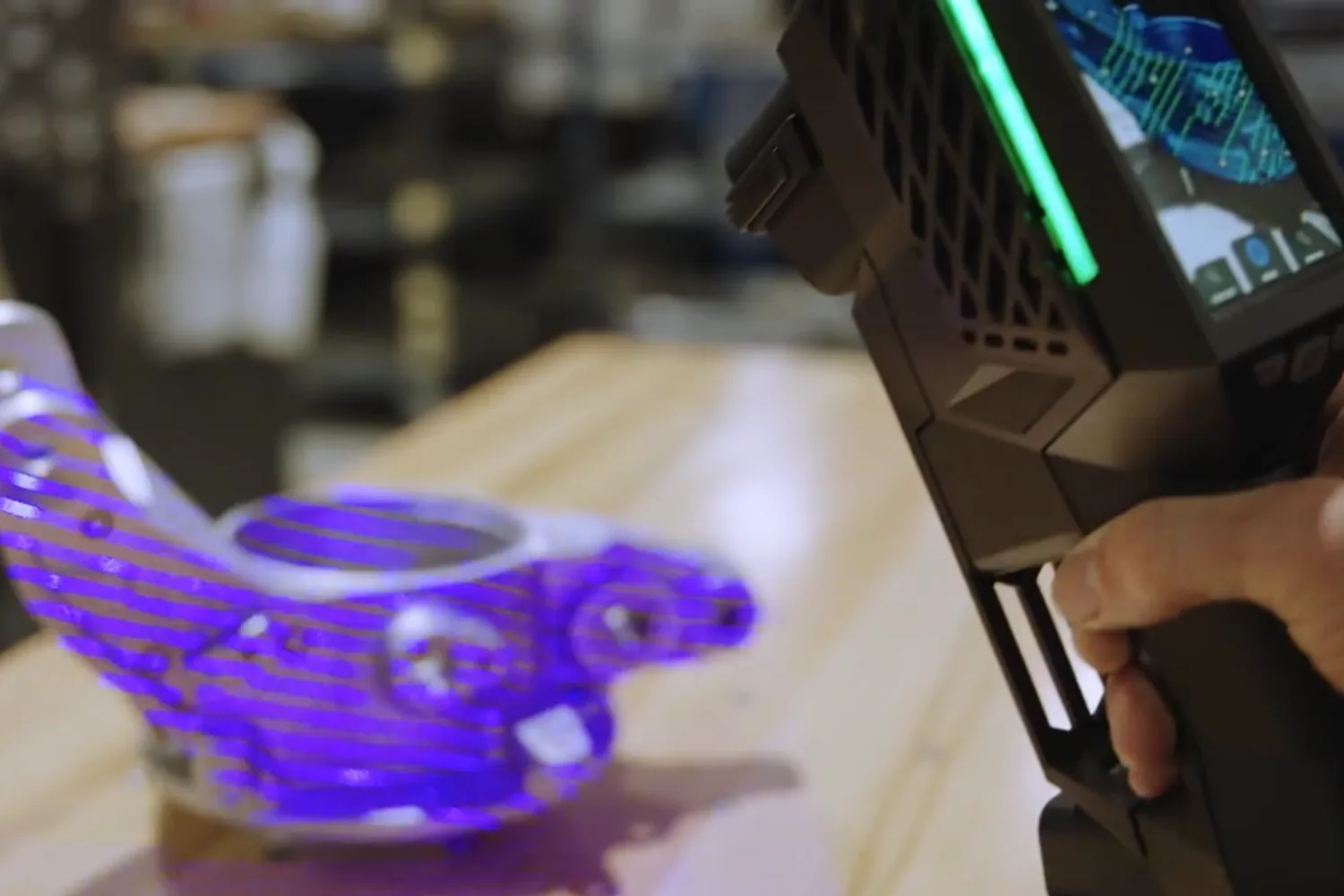
The HandySCAN EVO projects blue laser lines, from 22 on the EVO to 46 on the EVO Elite, and triangulates them. It locates itself from positioning targets on or around the part, which is what holds its accuracy, and it records geometry without color. The Artec Leo projects structured light from a VCSEL source and tracks on the object's geometry and texture, so it needs no targets and records 2.3 MP color texture. The Leo also carries its own NVIDIA Jetson TX2 processor, 5.5-inch touchscreen and battery, so it builds the model in real time without a computer. The EVO connects to a computer over USB 3.0, or wirelessly through Creaform's Mobility Kit.
Which is more accurate?
The HandySCAN EVO, by a clear margin. Creaform rates the EVO and EVO Plus at 0.025 mm and the EVO Elite at 0.020 mm, with volumetric accuracy of 0.020 mm + 0.040 mm/m or 0.020 mm + 0.020 mm/m, tested in an ISO/IEC 17025-accredited lab. Artec rates the Leo at up to 0.1 mm, and 0.1 mm + 0.3 mm/m over distance. On a part 2 m long, that difference in the length term adds up. If your drawing carries tolerances in the hundredths of a millimeter, the EVO is the scanner built for it. If you need the shape for redesign, fit checks or visualization, the Leo's accuracy is usually enough.
Which is faster and easier to use?
For a new operator, the Leo is quicker to start: switch it on, walk around the object and watch the model build on its screen, with no targets to place and no cable to manage. Its far field of view of 838 × 488 mm covers large surfaces in few passes. The EVO asks you to place targets first, then scans fast, at up to 2,800,000 measurements per second on the Elite, with its touchscreen showing coverage on the scanner. Creaform.OS adds CAD-based auto-alignment and automatic cleanup, which saves time on repeat inspections. For one-off capture the Leo wins on setup; for repeat checks of the same part the EVO's workflow pays off.
Which parts suit each scanner?
Creaform recommends the EVO for parts from 0.05 to 4 m: castings, machined housings, sheet-metal parts, tooling and molds, especially shiny or dark metal where accuracy matters. Artec rates the Leo for medium and large objects, about 0.2 to 2 m: gearboxes, car parts, turbines, small boats, furniture, statues and people. The Leo's color and lack of targets suit organic shapes and surfaces you cannot mark. The EVO's laser lines and accredited accuracy suit metal parts that go into an inspection report. For very large parts, look beyond both: the HandySCAN MAX EVO or a MetraSCAN on the Creaform side, or the Leo with a Ray II on the Artec side.
What else do buyers ask about the HandySCAN EVO and the Artec Leo?
Is the Artec Leo accurate enough for inspection?
For general form and fit checks, often yes; for tight-tolerance inspection, usually not. Artec rates the Leo at up to 0.1 mm, and 0.1 mm + 0.3 mm/m over distance. Artec Studio can compare a Leo scan with CAD and show a deviation map. If your tolerances are in the hundredths of a millimeter, a metrology scanner such as the HandySCAN EVO, rated at 0.020 to 0.025 mm by model, is the safer tool.
Can the HandySCAN EVO capture color like the Leo?
No. The HandySCAN EVO records geometry only. Its EVO Plus and EVO Elite models add a 12 MP AR-enabled camera, but it is used for photos positioned on the 3D model and, on the EVO Elite, for deviation colormaps on the part, not for color texture on the mesh. If color texture is a requirement, the Leo, or Creaform's own Go!SCAN SPARK, records it during the scan.
Is the HandySCAN EVO wireless?
It can be, with the Mobility Kit: a belt-mounted module with swappable batteries that replaces the USB cable with a wireless link to the computer. Creaform states it gives the same accuracy as the cable. The Leo goes further, since it needs no computer at all during the scan: its onboard processor, screen, battery and 512 GB SSD make it a self-contained unit.
Which is better for reverse engineering?
It depends on the part. For machined parts with tight fits, the EVO captures more accurate geometry, and Creaform's Scan-to-CAD module turns it into CAD entities. For large, organic or painted parts where speed and color matter more, the Leo captures the shape quickly, and Artec Studio fits primitives and auto-surfaces it before export to SOLIDWORKS or Geomagic Design X. Many teams test their typical part on both.
See the HandySCAN EVO and the Artec Leo on your own work
Tell us the job that is hardest to measure today. We scan it where it is and show you the result, so you compare on your own work, not on a spec sheet. On-site demos are available in most areas; ask when you request.