Buyer's guide
Best 3D scanner for automotive work
Pick the right scanner for automotive work the first time: our four picks, ranked, from inspection on the shop floor to a whole vehicle captured in color.
Key takeaways
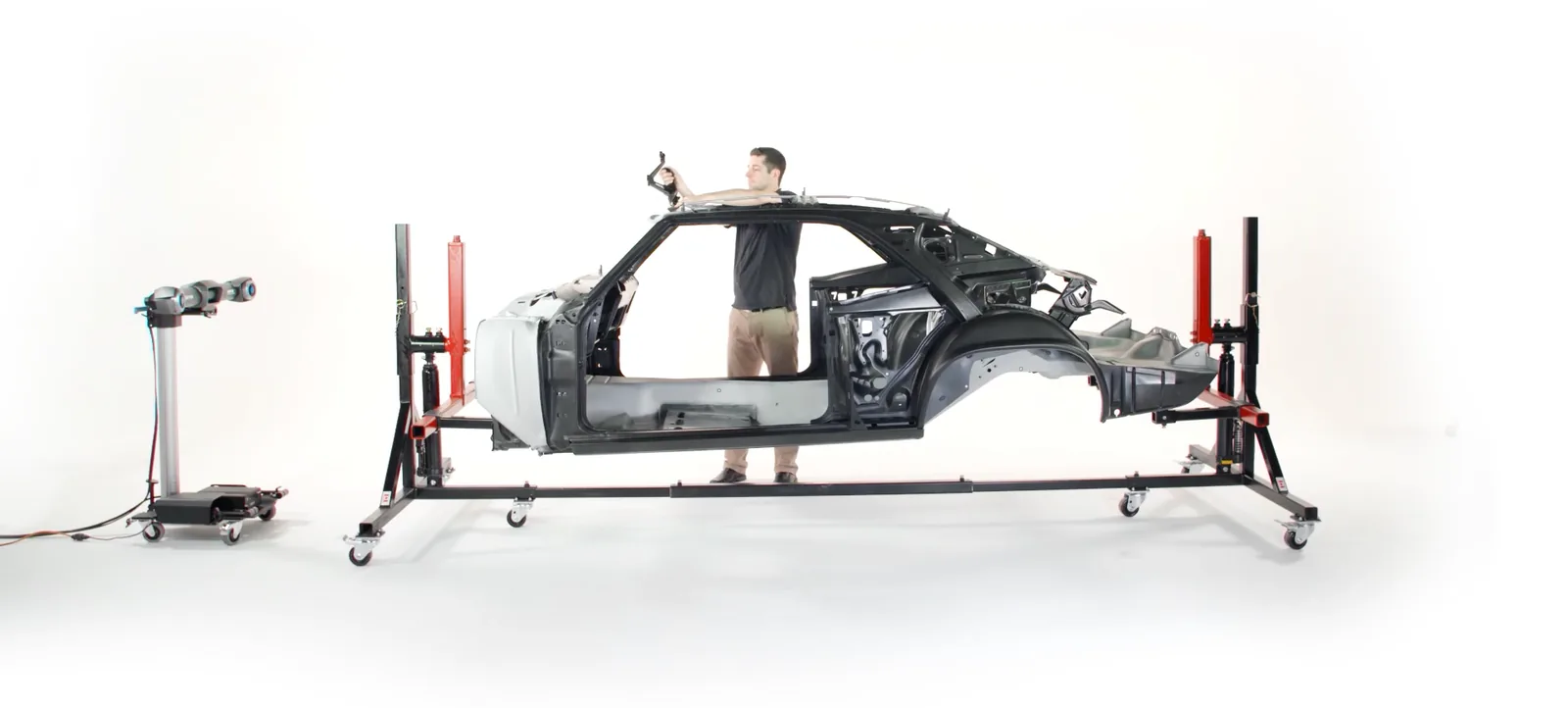
- The MetraSCAN 3D inspects body parts, castings and fixtures on the shop floor without targets, despite vibration.
- The HandySCAN EVO brings accredited 0.020 to 0.025 mm accuracy and AR colormaps (EVO Elite) to quality checks.
- The Artec Leo captures full vehicles and interiors in color with no cables or laptop.
- The Artec Spider II captures fine components such as brackets, connectors and trim details.
Which scanners do we pick for automotive work, and in what order?
We rank four. First, the Creaform MetraSCAN 3D: its C-Track follows both the scanner and the part, so body panels, castings and fixtures are inspected on a vibrating shop floor without targets, and a HandyPROBE can probe holes on the same tracker. Second, the HandySCAN EVO, portable metrology for first-article checks and machined parts, with a touchscreen on the scanner. Third, the Artec Leo, which captures a car, an engine bay or an interior in color with no cable. Fourth, the Artec Spider II, for clips, connectors and small brackets whose edges must come out sharp in CAD. Inspection leads the list because that is where an automotive scanner has to hold its accuracy every day; if your work is mostly design or aftermarket fitment, start from the Leo instead.
For the shop-floor jobs behind these picks, from fixture checks to discontinued parts, see 3D scanning for automotive and vehicle manufacturing.
Which jobs does a scanner for automotive work do most often?
These are the six jobs we see most often in automotive work: body panels and closures, fixture proving before launch, powertrain castings, discontinued part rebuild, aftermarket fitment and at-line inspection. Each card says what is scanned and what the scan is used for, so you can match your own work to the scanners recommended on this page. If your job is not listed, describe it when you request a demo, with what you would want scanned.
Body panels and closures
Check stamped panels for form, trim edges, holes and flush against CAD on the shop floor.
Fixture proving before launch
Probe locators and scan fixture surfaces so the first vehicle built on them is built right.
Powertrain castings
Check engine and transmission castings for stock before machining and for wear after service.
Discontinued part rebuild
Scan a surviving part, rebuild it in CAD and make a replacement or a short run.
Aftermarket fitment
Capture a vehicle, an engine bay or an interior so brackets and panels are designed to fit.
At-line inspection
Run the same inspection program on production parts beside the line with a robot-mounted scanner.
Which scanners are best for automotive work?
For automotive work, these four scanners are the strongest fits across the Creaform and Artec ranges, listed in the order we recommend them: MetraSCAN 3D, HandySCAN EVO, Leo and Spider II. Each card says why it earns its place and shows one headline fact taken from the maker's published specifications. We rank them for the jobs described on this page; the size of what you scan, the accuracy you need and your surfaces can move a lower pick to the top. Compare them side by side in the table, then see the one you favor scan your own work before you decide.
Creaform
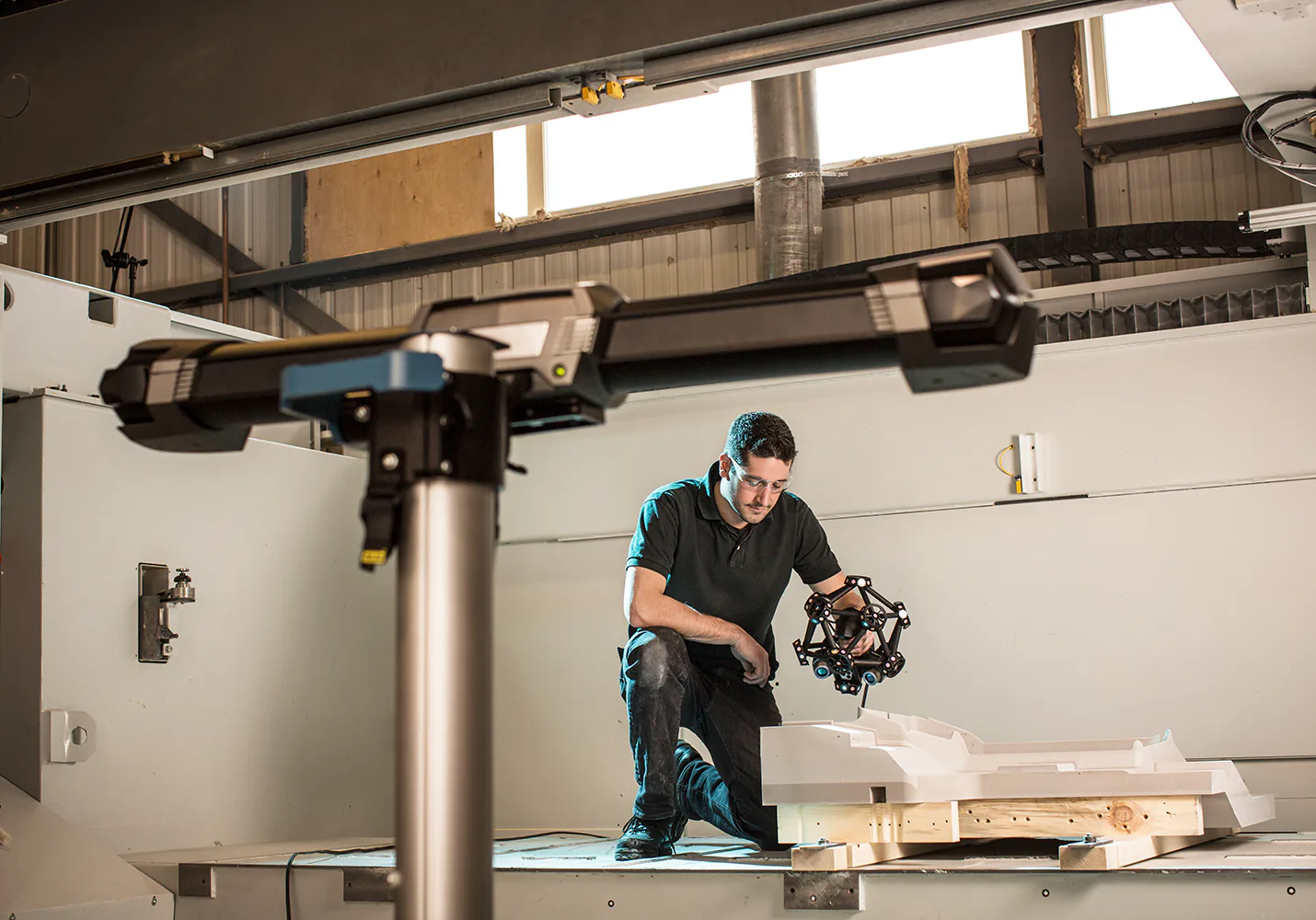
MetraSCAN 3D
Optical CMM 3D scanner with C-Track optical tracker
Shop-floor inspection of body panels, castings, fixtures and assemblies, target-free and insensitive to vibration. Pair a HandyPROBE on the same C-Track to probe holes and datums.
- Accuracy
- 0.025–0.035 mm (by model)
Creaform
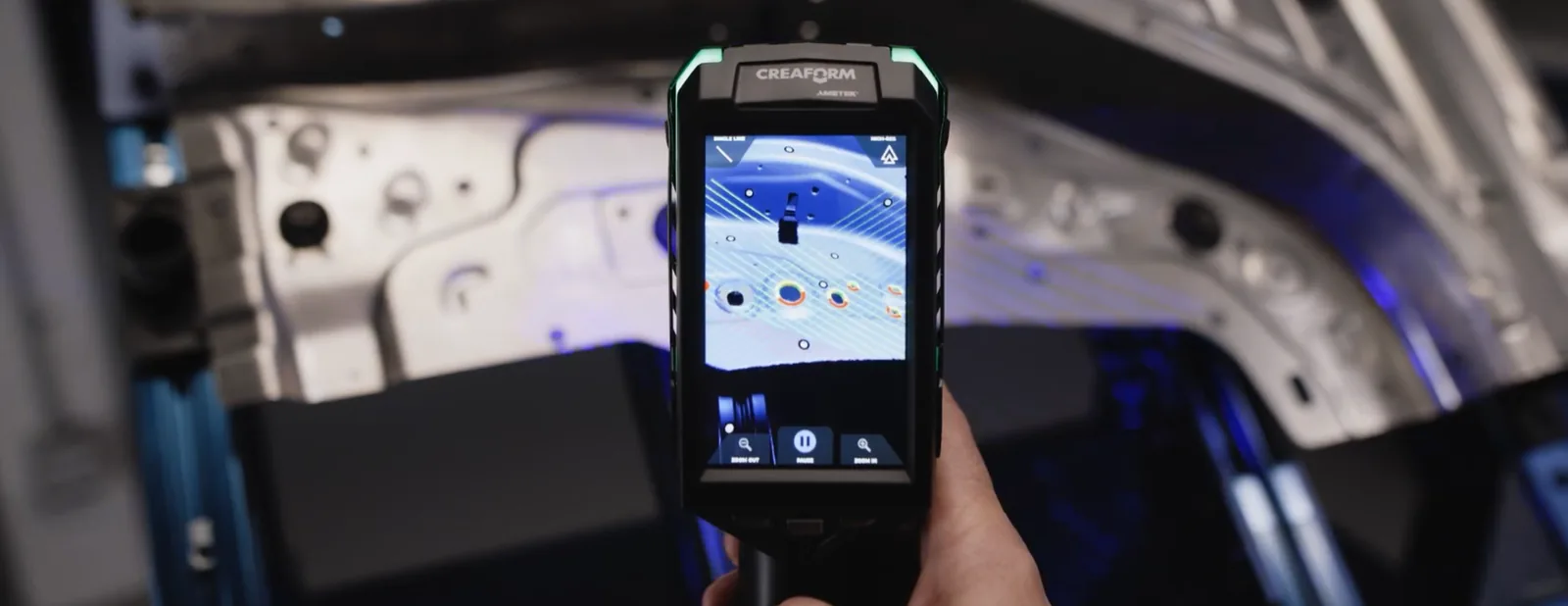
HandySCAN EVO
Handheld metrology-grade blue-laser 3D scanner
Portable metrology for first-article checks, tooling and reverse engineering of machined parts, with a touchscreen on the scanner and a wireless option.
- Accuracy
- 0.020–0.025 mm (by model)
Artec
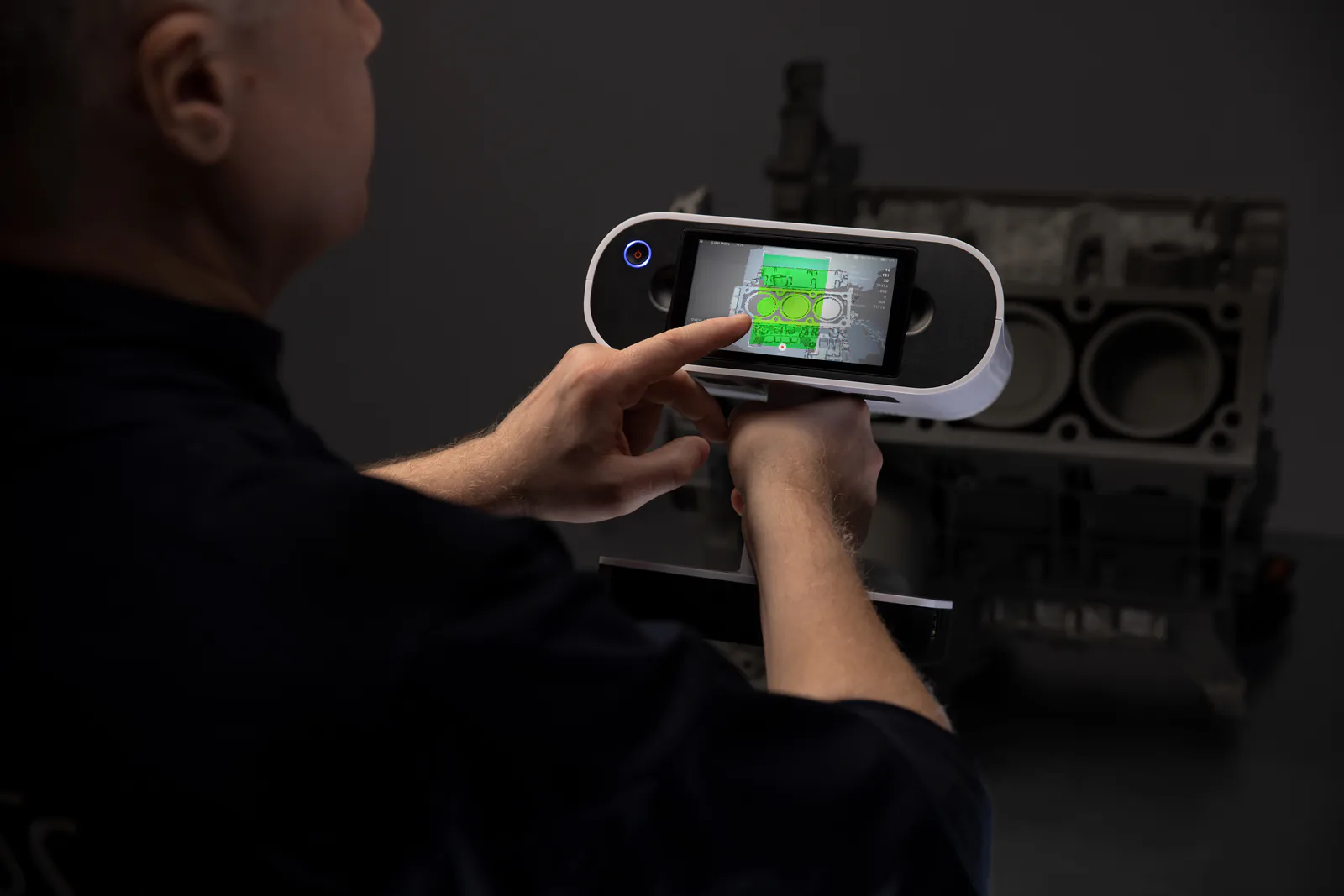
Leo
Wireless handheld 3D scanner with onboard processing
Walk around a car, an engine bay or an interior and capture it in color with no cable, then fit primitives and export to CAD from Artec Studio.
- Recommended part size
- 0.2–2 m
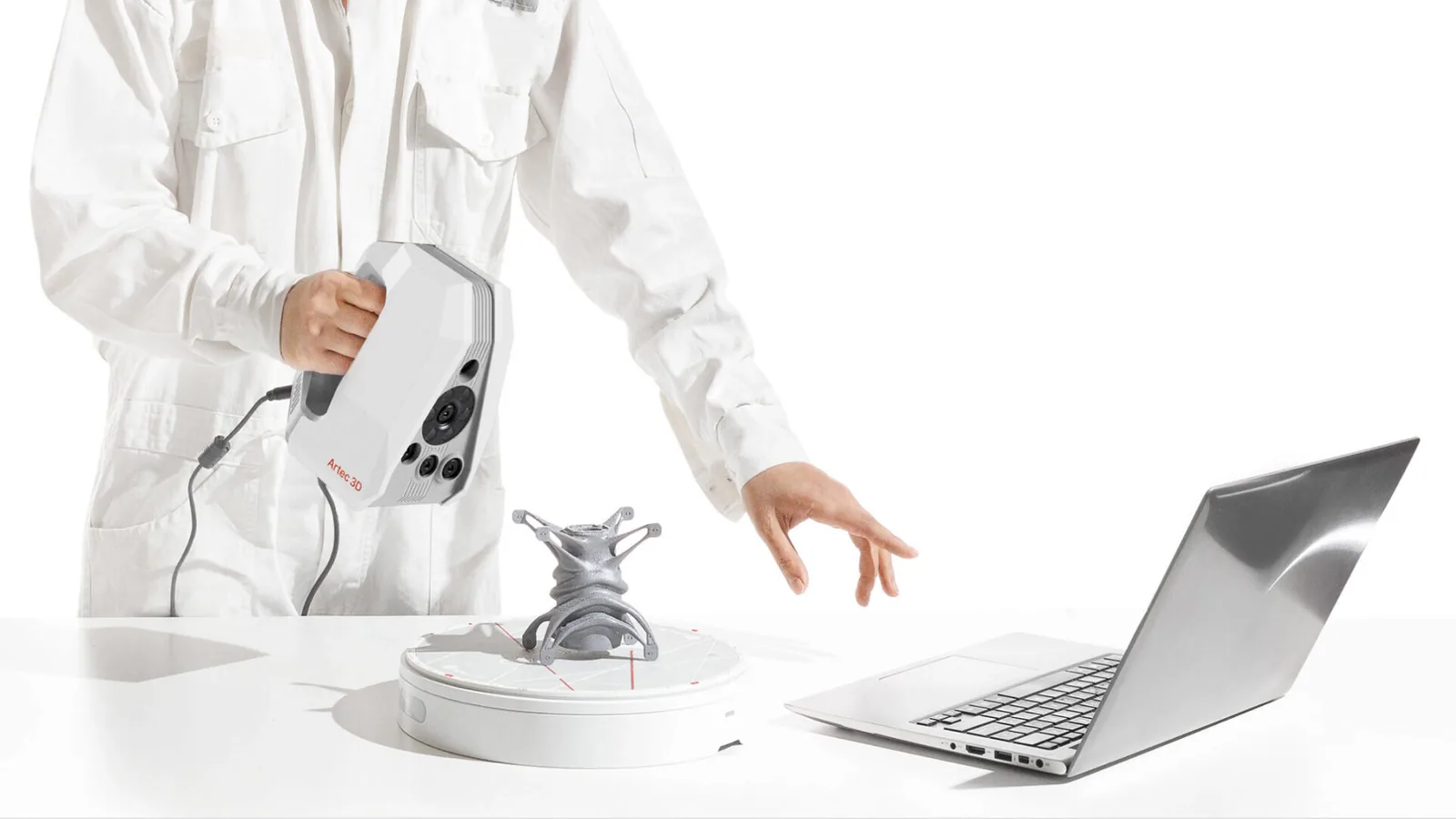
Artec
Spider II
Handheld high-resolution blue-light 3D scanner
Fine components and aftermarket details, captured without targets: clips, connectors, badges and small brackets that need sharp edges in CAD.
- Resolution
- 0.05 mm
| Specification | MetraSCAN 3D | HandySCAN EVO | Leo | Spider II |
|---|---|---|---|---|
| Technology | Blue laser triangulation with optical tracking | Blue laser triangulation | Structured light (VCSEL) | Blue-light structured light |
| Accuracy | 0.025–0.035 mm (by model) | 0.020–0.025 mm (by model) | Up to 0.1 mm | 0.05 mm |
| Recommended part size | 0.2–6 m (BLACK+, BLACK+ Elite); 0.2–10 m (BLACK2) | 0.05–4 m | 0.2–2 m | 50–500 mm |
| Positioning targets | Not needed | Required | Not needed | Not needed |
| Color texture | No | No | Yes | Yes |
| Wireless operation | No (cable) | With the Mobility Kit (accessory) | Yes | No (cable) |
| Measurement speed | 1,800,000–2,800,000 measurements/s (by model) | 1,300,000–2,800,000 measurements/s (by model) | Up to 35,000,000 points/s (HD); 3,000,000 points/s (SD) | Up to 8,000,000 points/s |
| Weight | Scanner 1.49 kg; C-Track 5.7 kg | 1.02–1.04 kg (by model) | 2.6 kg | 0.95 kg |
Specs checked:
What matters for automotive inspection?
Accredited accuracy, shop-floor robustness and repeatability. Production parts are inspected near the line, where floors vibrate and parts move, so a system that tracks both the scanner and the part, like the MetraSCAN 3D with its C-Track, keeps results stable. For portable checks, the HandySCAN EVO and BLACK Elite bring accredited accuracy and CAD-based alignment. For many parts per day, Creaform's R-Series puts a MetraSCAN-R on a robot or in a CUBE-R cell. In each case, confirm the Inspection software produces the reports your customers require.
What matters for automotive reverse engineering and design?
Coverage, color and the path to CAD. For a whole vehicle, an interior or an engine bay, the Artec Leo's wireless operation and wide field of view save time, and color helps match trim and materials. For small components, the Spider II's fine resolution keeps edges sharp. For mating parts such as brackets and mounts, a metrology scanner such as the HandySCAN PRO or EVO keeps fits accurate. Artec Studio and Creaform's Scan-to-CAD module both hand geometry to SOLIDWORKS and other CAD systems.
What else do buyers ask about scanners for automotive work?
Can I scan a whole car with a handheld scanner?
Yes. The Artec Leo is often used on full vehicles because it needs no cable or laptop and covers large surfaces quickly, and Artec says it can scan in sunlight. For higher accuracy on a large body, the HandySCAN MAX EVO handles parts up to 15 m. The Artec Ray II can also capture a vehicle from a tripod, which Artec says takes minutes.
Which scanner suits fixture and tooling checks?
The MetraSCAN 3D and HandyPROBE suit them well: they measure fixtures where they are installed, without targets, and the HandyPROBE probes locating pins, holes and datums like a CMM. Portable HandySCAN scanners also verify tooling and molds. Creaform's Inspection module reports deviations against the fixture's CAD model.
How do I reverse engineer a discontinued auto part?
Scan the part, or a good example of it, then rebuild it in CAD from the mesh. A blue-laser scanner such as the HandySCAN PRO captures machined and mating features accurately, and its included Scan-to-CAD Pro builds solids. For larger or curved parts, the Artec Leo captures the shape quickly, and Artec Studio fits primitives and auto-surfaces it before export.
Can scanning be automated on a production line?
Yes. Creaform's R-Series mounts a MetraSCAN-R on an industrial or collaborative robot, or delivers it inside a CUBE-R measuring cell for parts up to 2, 3 or 4 m. Robot paths are planned offline in the Automation module, so operators need no robotics expertise, and the C-Track keeps the scanner accurate despite line vibration.
See these scanners on your own work
Choose the job that matters most, whether that is a part, a person or a whole building. We scan it where it is with the scanner you choose and show you the result. On-site demos are available in most areas; ask when you request.