Buyer's guide
Best 3D scanner for small, intricate parts
Capture the thin ribs, sharp edges and fine engravings that small parts depend on, without touching or marking them.
Key takeaways
- The Artec Micro II measures small parts at 5 microns on an automated desktop stage, for objects up to 200 × 200 × 150 mm.
- The Artec Spider II captures fine detail handheld at 0.05 mm accuracy and resolution, without targets.
- The HandySCAN BLACK Elite resolves 0.750 mm pins and 0.500 mm walls on metal parts, with accredited 0.025 mm accuracy.
- All three suit inspection; the Spider II and Micro II also record color.
What matters most when scanning small parts?
Resolution and accuracy at small scale. A small part's critical features, thin walls, small holes, sharp edges and engravings, can be a fraction of a millimeter, so the scanner must sample finely enough to show them and measure accurately enough to trust them. Field of view matters too: a scanner built for large objects wastes most of its frame on a small part. Then consider handling: small parts are easy to move and hard to mark with targets, which favors target-free scanners or an automated stage. The Artec Micro II and Spider II are built for this class, and Creaform's blue-laser HandySCAN scanners resolve fine features on metal parts.
Which jobs does a scanner for small, intricate parts do most often?
These are the six jobs we see most often in small, intricate parts: connectors and small precision parts, jewelry and watch parts, dental items and small medical parts, coins, inscriptions and small artifacts, gears, splines and fine machined features and small castings and printed parts. Each card says what is scanned and what the scan is used for, so you can match your own work to the scanners recommended on this page. If your job is not listed, describe it when you request a demo, with what you would want scanned.
Connectors and small precision parts
Measure small molded or machined parts against CAD on an automated stage, the same way every time.
Jewelry and watch parts
Capture fine edges, stone settings and engravings in color for design, repair or replicas.
Dental items and small medical parts
Digitize dental items and small device components in fine detail and color.
Coins, inscriptions and small artifacts
Record raised and engraved detail without touching or marking the object.
Gears, splines and fine machined features
Capture teeth, ribs and thin walls with enough resolution to rebuild or inspect them.
Small castings and printed parts
Check small castings and printed parts for shrink, warp and missing detail against their model.
Which scanners are best for small, intricate parts?
For small, intricate parts, these three scanners are the strongest fits across the Creaform and Artec ranges, listed in the order we recommend them: Micro II, Spider II and HandySCAN BLACK Elite. Each card says why it earns its place and shows one headline fact taken from the maker's published specifications. We rank them for the jobs described on this page; the size of what you scan, the accuracy you need and your surfaces can move a lower pick to the top. Compare them side by side in the table, then see the one you favor scan your own work before you decide.
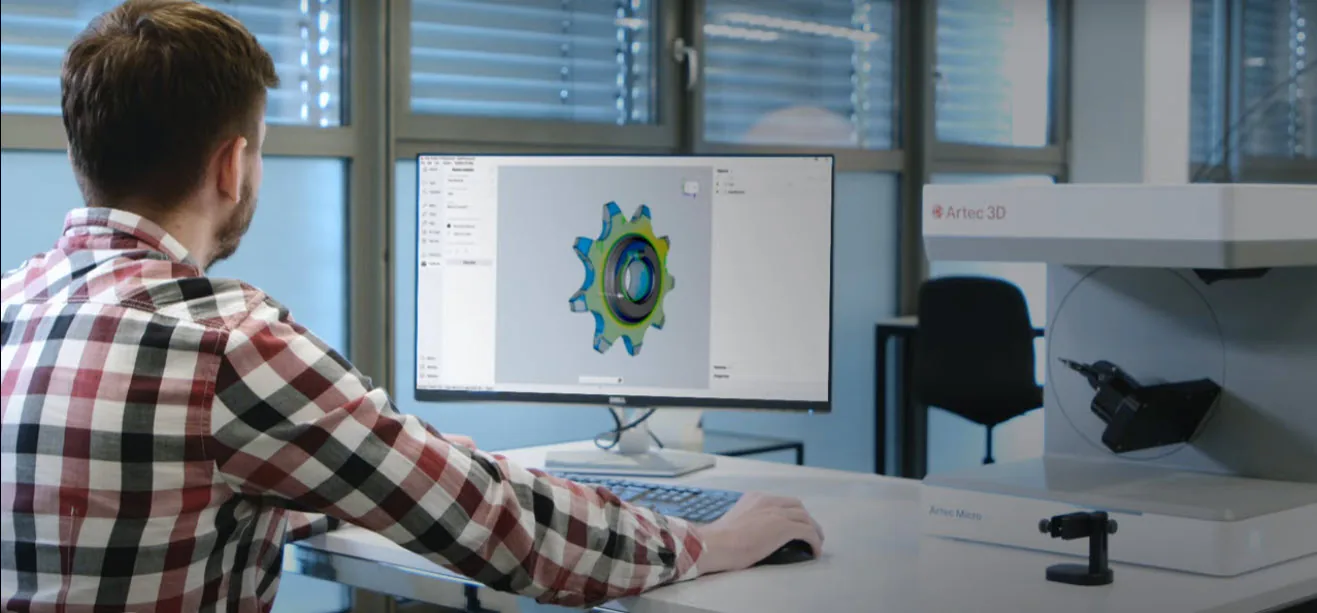
Artec
Micro II
Automated desktop 3D scanner
The most precise option for parts that fit on its stage: one click, an automatic path, four 13 MP cameras and color, with 2-micron repeatability for production checks.
- Accuracy
- 5 microns (0.005 mm)
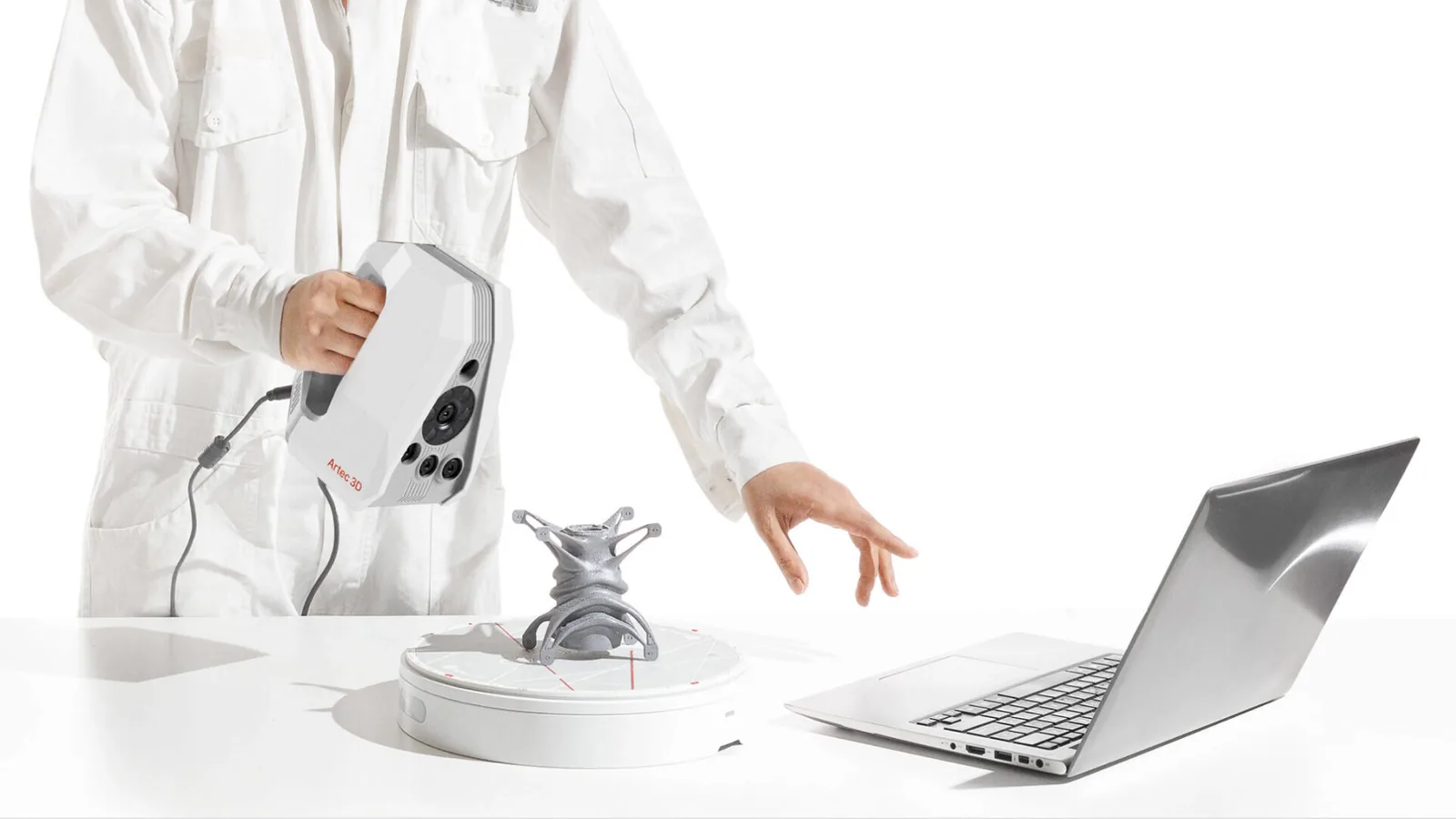
Artec
Spider II
Handheld high-resolution blue-light 3D scanner
Handheld fine detail without targets, for parts from coin size up to engine components, including parts that cannot be moved or marked.
- Resolution
- 0.05 mm
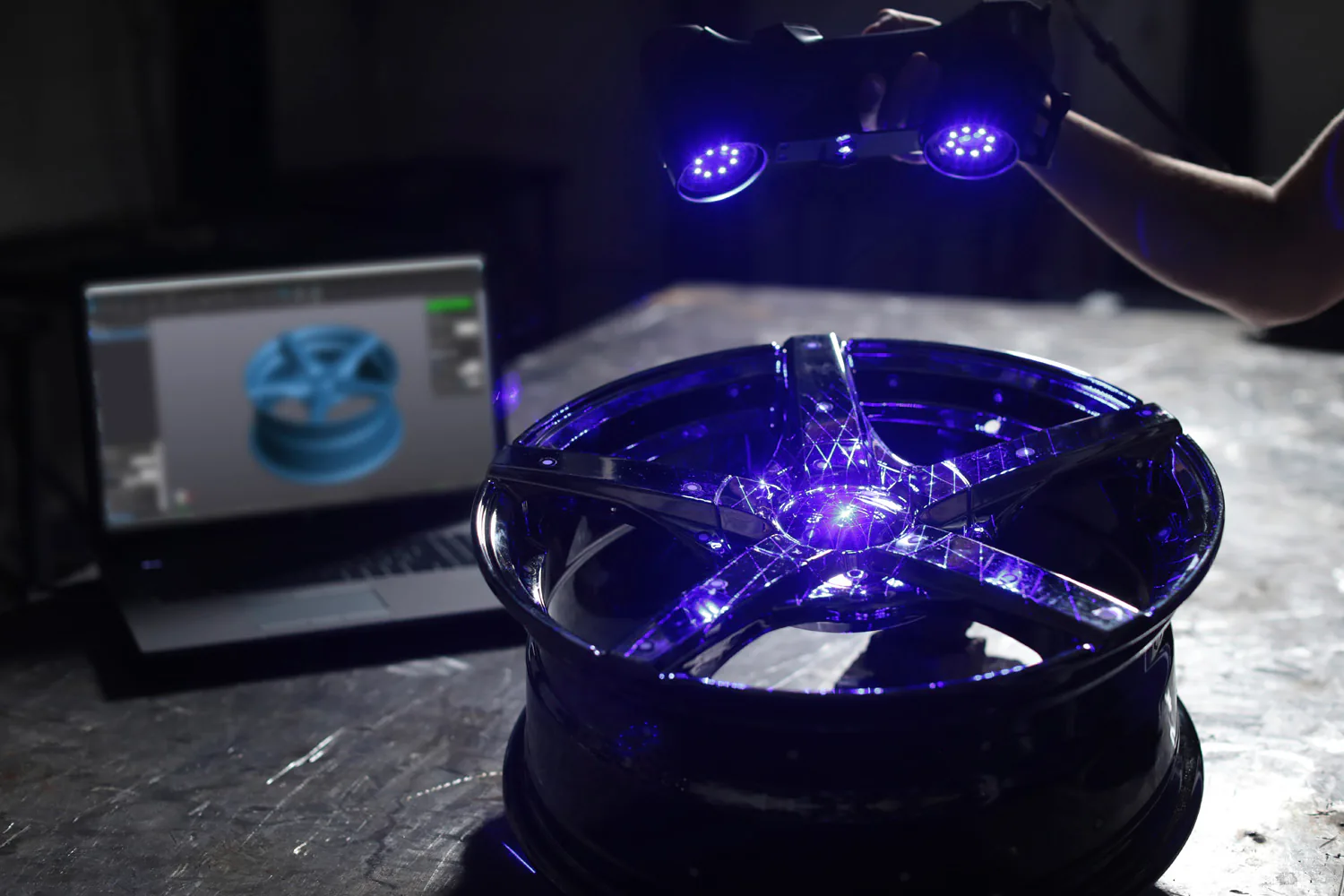
Creaform
HandySCAN BLACK Elite
Handheld metrology-grade blue-laser 3D scanner
A light, metrology-grade blue-laser scanner that handles shiny and dark metal and resolves small features, with accredited accuracy for inspection reports.
- Accuracy
- 0.025 mm
| Specification | Micro II | Spider II | HandySCAN BLACK Elite |
|---|---|---|---|
| Technology | Structured light (RGB LED), automated desktop | Blue-light structured light | Blue laser triangulation |
| Accuracy | 5 microns (0.005 mm) | 0.05 mm | 0.025 mm |
| Resolution | 40 microns | 0.05 mm | 0.025 mm |
| Field of view | Ø 20 × 15 cm | 128 × 104 mm / 171 × 152 mm | Not published |
| Recommended part size | 200 × 200 × 150 mm, 2 kg | 50–500 mm | 0.05–4 m |
| Positioning targets | Not needed | Not needed | Required |
| Color texture | Yes | Yes | No |
| Weight | 12 kg | 0.95 kg | 0.94 kg |
Specs checked:
Should I choose a desktop or a handheld scanner for small parts?
Choose a desktop scanner when every part fits on its stage and you want the tightest, most repeatable numbers: the Artec Micro II takes objects up to 200 × 200 × 150 mm and 2 kg and scans them automatically, so two operators get the same result. Choose a handheld when part sizes vary, when parts sit in an assembly, or when they cannot be moved: the Artec Spider II covers objects from about 5 to 50 cm, and Creaform's HandySCAN BLACK Elite covers small metal parts up to large ones in one tool.
How fine a detail can these scanners resolve?
Check resolution as well as accuracy. The Artec Micro II has 40-micron resolution and 5-micron accuracy. The Spider II has 0.05 mm resolution and accuracy, and Artec states it picks up inscriptions, sharp edges and deep holes. Creaform publishes feature limits for the HandySCAN BLACK Elite and EVO Series at a 0.3 m working distance: 0.750 mm pins, 1.250 mm holes, 0.500 mm walls and 0.025 mm steps. Compare those limits with the smallest feature your CAD rebuild or inspection depends on.
Can small parts be scanned without marking them?
Yes. The Artec Micro II needs no targets because its stage and four cameras handle positioning, and the Spider II tracks on the part's geometry and color texture. That keeps fine detail uncovered and suits medical, dental, jewelry and finished parts that must stay clean. Blue-laser scanners such as the HandySCAN BLACK Elite use positioning targets; on small parts, place them on a fixture or plate around the part instead of on it.
What else do buyers ask about scanners for small, intricate parts?
What is the most accurate scanner for small parts?
Among the scanners we offer, the Artec Micro II, rated at 5 microns (0.005 mm) and certified to ISO 12836, with 2-micron repeatability. It takes objects up to 200 × 200 × 150 mm and 2 kg. For handheld scanning of small parts, the Artec Point II, rated at up to 0.02 mm, and the HandySCAN EVO Elite, at 0.020 mm, are the most accurate options.
Can a handheld scanner capture very small features?
Yes, within limits. The Artec Spider II resolves 0.05 mm and is used on coins, inscriptions and fine mechanical parts. Creaform's HandySCAN BLACK Elite resolves 0.750 mm pins and 0.500 mm walls at its working distance. For features smaller than a handheld scanner can resolve, a desktop scanner such as the Micro II is the better tool.
Which small-part scanners capture color?
The Artec Micro II records color natively and can add higher-resolution photo texture, and the Spider II records 5 MP color texture. Creaform's HandySCAN scanners record geometry only. Color helps for jewelry, heritage objects, medical models and any part where markings or materials need to show in the model.
Is the Artec Spider II or Micro II better for inspection?
For small precision parts that fit on its stage, the Micro II: its 5-micron accuracy and automated, repeatable scanning suit production inspection. The Spider II inspects at 0.05 mm and suits parts that are too large for the stage, parts in assemblies, or parts that cannot be moved. Both compare scans with CAD in Artec Studio.
See these scanners on your own work
Choose the job that matters most, whether that is a part, a person or a whole building. We scan it where it is with the scanner you choose and show you the result. On-site demos are available in most areas; ask when you request.