Scanner comparison
Artec Leo vs Artec Eva
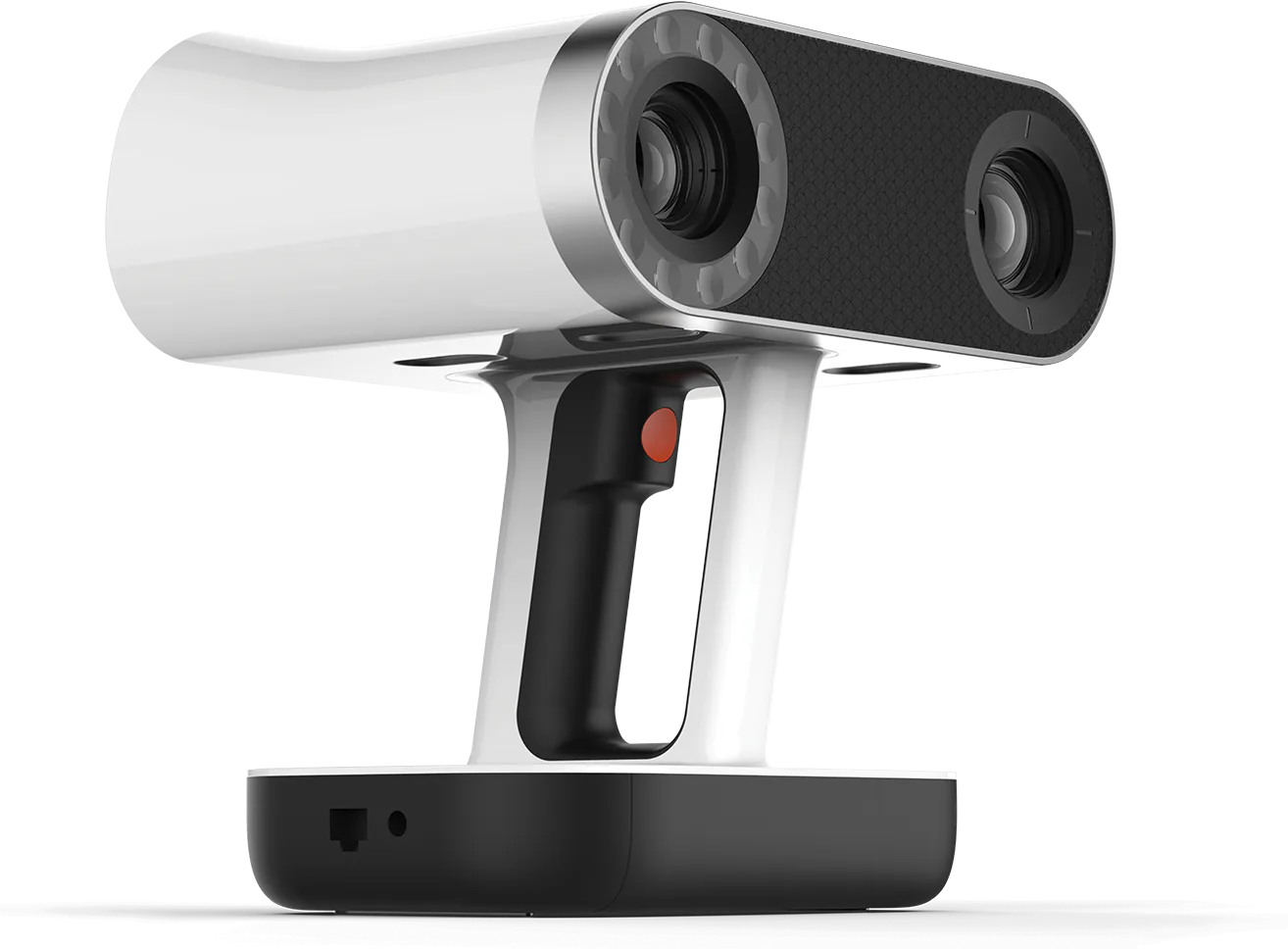
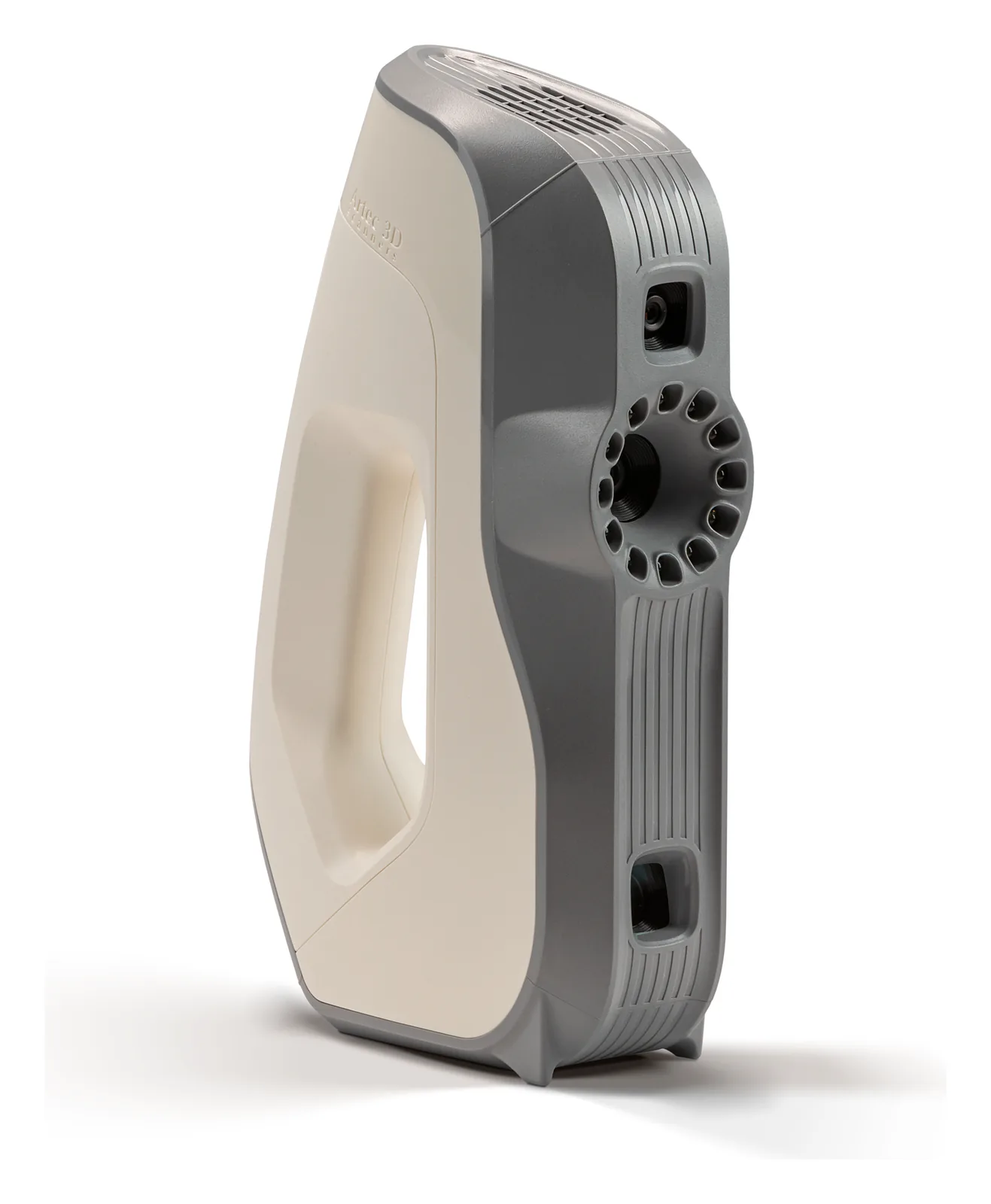
Artec's two best-known structured-light scanners share the same stated accuracy and color capture. What separates them is how you work: the Leo is a self-contained wireless scanner, the Eva a light scanner tethered to a computer.
Key takeaways
- Both are rated at up to 0.1 mm point accuracy and 0.1 mm + 0.3 mm/m over distance, with up to 0.2 mm resolution in HD mode.
- The Leo is fully wireless with onboard processing; the Eva connects to a computer by USB.
- Weight: 2.6 kg for the Leo and 0.9 kg for the Eva.
- The Leo's capture zone is 160,000 cm³ against the Eva's 61,000 cm³, so it covers large objects faster.
- Both track on geometry and color with no targets, and both run in Artec Studio.
Which should you choose: Artec Leo or Artec Eva?
Choose the Artec Leo when you scan medium to large objects, work in the field, or want no laptop or cable at all: it has its own processor, 5.5-inch touchscreen, battery and 512 GB SSD, a 160,000 cm³ capture zone and up to 35 million points per second. Choose the Artec Eva when your objects are mostly medium-sized, you scan near a computer, and you value a light 0.9 kg scanner and a simpler setup for people, medical fitting and design work. Both are rated at up to 0.1 mm with color texture and no targets, so the decision is about workflow and object size, not accuracy.
Who the Artec Leo suits
- Field and on-site scanning with no power outlet, cable or laptop cart.
- Large objects such as vehicles, boats, machinery and room interiors.
- Teams that want scans uploaded to Artec Cloud for colleagues to review in a browser.
- Outdoor work, since Artec says the Leo's light source works in sunlight.
Who the Artec Eva suits
- Bench and studio scanning near a computer, where a 0.9 kg scanner is easy to handle.
- Scanning people for orthotics, prosthetics and medical fitting.
- Medium objects from about 10 cm up: parts, busts, heritage objects and props.
- Teams that want a lighter, wired color scanner and do not need onboard processing.
How do the Leo and Eva specs compare?
The table lines up the published specifications of the Leo and the Eva, read from artec3d.com and never retyped. Where a scanner comes in several models, a cell shows the range across them or names each model. 'Not published' means the maker does not state that figure. Compare single-point accuracy with volumetric accuracy at your own part length, then check targets, color and wireless use against the way your team works. The verdict above explains which differences matter for which jobs.
| Specification | Artec Leo | Artec Eva |
|---|---|---|
| Technology | Structured light (VCSEL) | White structured light |
| Accuracy | Up to 0.1 mm | Up to 0.1 mm |
| Volumetric accuracy | Up to 0.1 mm + 0.3 mm/m | Up to 0.1 mm + 0.3 mm/m |
| Resolution | Up to 0.2 mm (HD mode) | Up to 0.2 mm (HD mode) |
| Measurement speed | Up to 35,000,000 points/s (HD); 3,000,000 points/s (SD) | Up to 18,000,000 points/s |
| Working distance | 0.35–1.2 m | 0.4–1 m |
| Field of view | 244 × 142 mm / 838 × 488 mm | 214 × 148 mm |
| Volume capture zone | 160,000 cm³ | 61,000 cm³ |
| Recommended part size | 0.2–2 m | 0.1–2 m |
| Positioning targets | Not needed | Not needed |
| Color texture | Yes | Yes |
| Wireless operation | Yes | No (cable) |
| Connection | Wi-Fi, Ethernet | 1 × USB 2.0, USB 3.0 compatible |
| Weight | 2.6 kg | 0.9 kg |
Specs checked:
How do the Leo and Eva work differently?
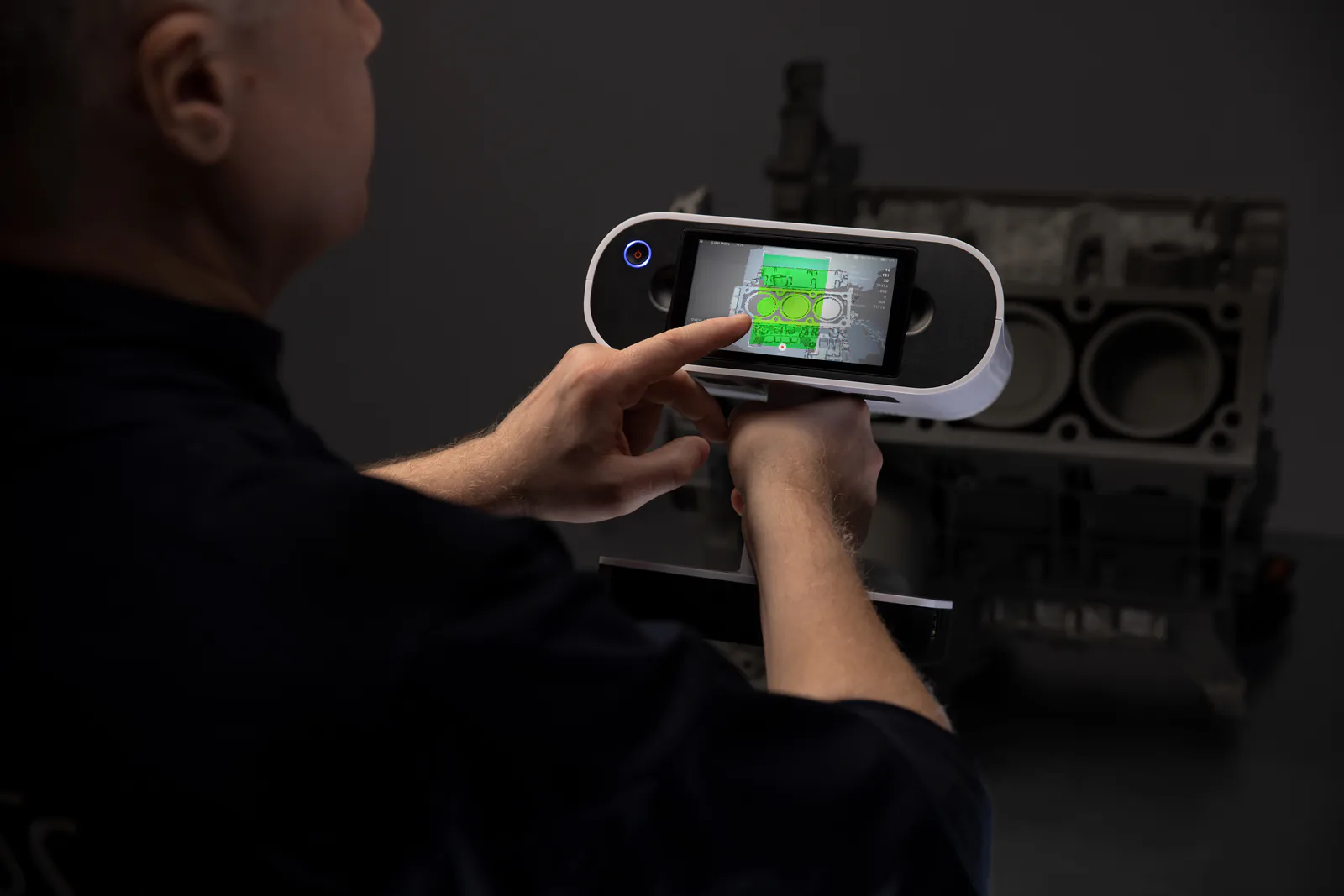
Both project structured light and track on the object's geometry and color, so neither needs targets. The Eva uses a flash light source and sends its frames over USB to Artec Studio on a computer, which reconstructs the model as you scan. The Leo uses a VCSEL light source that Artec says works in sunlight, and carries an NVIDIA Jetson TX2 processor, a 5.5-inch tilting touchscreen, a swappable battery and a 512 GB SSD, so it reconstructs the model on the scanner itself. Afterward, both hand their data to Artec Studio for processing, scan-to-CAD and inspection, and the Leo can send scans straight to Artec Cloud over Wi-Fi.
Is one more accurate than the other?
No. Artec states the same figures for both: up to 0.1 mm point accuracy, 0.1 mm + 0.3 mm/m over distance, and resolution up to 0.2 mm in HD mode. HD mode in Artec Studio recovers thin features, sharp edges and black or shiny areas on both scanners. The practical difference is coverage: the Leo's larger field of view, up to 838 × 488 mm at the far end, and its higher capture rate mean fewer passes on large objects. For detail finer than 0.1 mm, pair either one with a Spider II or Neo and merge the data.
Which is easier to use?
Both are easy, in different ways. The Eva is light, at 0.9 kg, and simple: plug it into a laptop, start Artec Studio and scan, with Autopilot handling processing settings. The Leo is heavier, at 2.6 kg, but removes the laptop and cable entirely: you see the model build on its own screen, with distance and coverage cues, and walk freely around a car or a boat. Over a long session the Eva is kinder to the arm; around large objects or outdoors the Leo is quicker because nothing tethers you. Teams often keep an Eva at the bench and take a Leo into the field.
Which objects suit each scanner?
Artec places the Eva from about 10 cm up, with a sweet spot around 20 cm to 2 m: wheels, busts, body parts, exhaust systems and medical fitting. It works 0.4 to 1 m from the surface. The Leo is rated for medium and large objects, about 20 cm to 2 m, and Artec says it can take on bigger objects and whole rooms with a powerful processing computer: gearboxes, castings, turbines, boats, furniture, statues and crime scenes, from 0.35 to 1.2 m away. If most of your objects fit on a table, the Eva covers them; if they are the size of a vehicle or sit outdoors, the Leo fits better.
What else do buyers ask about the Artec Leo and the Artec Eva?
Is the Artec Leo more accurate than the Eva?
No. Artec states the same accuracy for both: up to 0.1 mm per point and 0.1 mm + 0.3 mm/m over distance, with resolution up to 0.2 mm in HD mode. The Leo's advantages are wireless operation, onboard processing and a larger capture zone, which make large objects quicker to cover, not a tighter accuracy figure.
Does the Artec Eva need a computer while scanning?
Yes. The Eva connects to a computer or tablet over USB, and Artec Studio reconstructs the scan there. It can run on AC power or an external battery pack, which Artec says gives up to 6 hours of power, so with a tablet you can still scan where there is no outlet. The Leo needs no computer until processing.
Can Leo and Eva data be combined?
Yes. Artec Studio merges data from Artec scanners in one project, so you can capture a large object with the Leo and add detail areas from the Eva, or from a Spider II for finer detail. The software builds the model from the best data each scanner provides.
Which is better for scanning people?
Both are used on people: the Eva projects white light, and the Leo's VCSEL light source is laser class 1. The Eva is the more common choice in medical fitting because it is light, fast to start and works close to the body from 0.4 to 1 m. The Leo suits full-body or scene scanning, where walking around without a cable helps. In both cases the person must hold still for the whole scan.
See the Artec Leo and the Artec Eva on your own work
Tell us the job that is hardest to measure today. We scan it where it is and show you the result, so you compare on your own work, not on a spec sheet. On-site demos are available in most areas; ask when you request.