Skip to content
(816) 608-7745Get pricingBook a demo

ArtecWireless hybrid handheld metrology scanner

Artec Neo

A wireless handheld scanner that uses targets only where a tolerance must hold and scans target-free everywhere else.

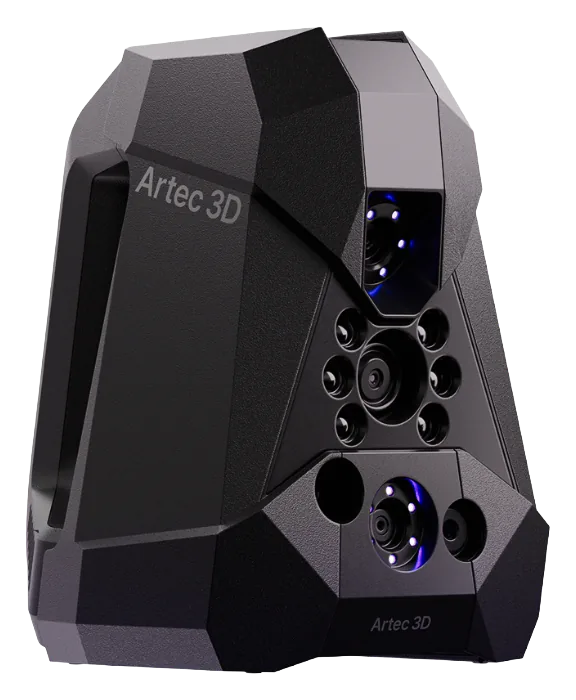
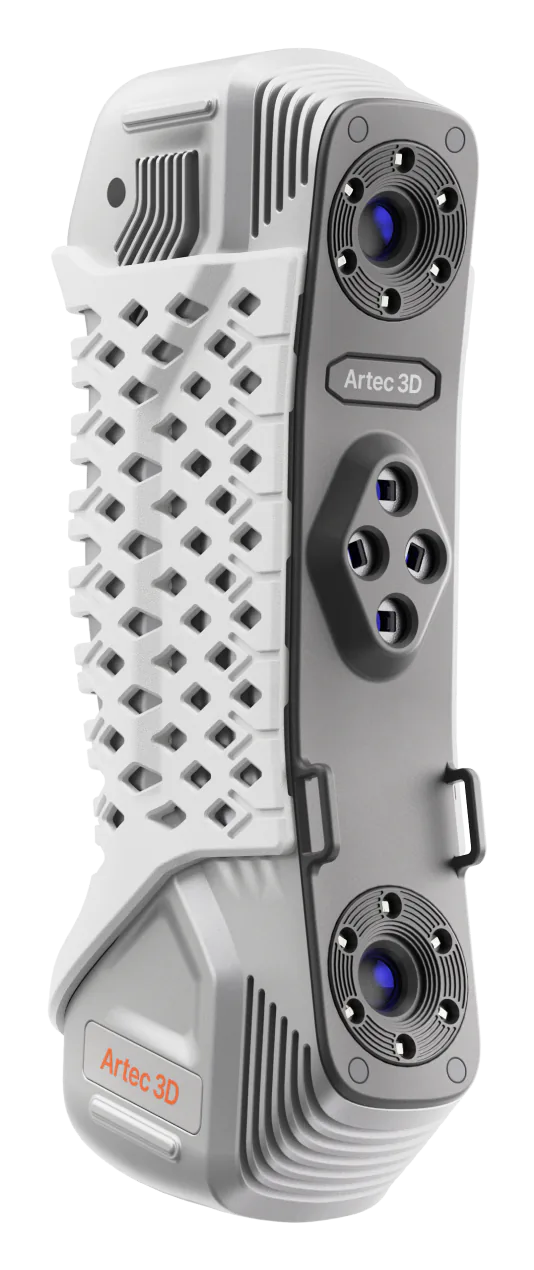
Artec Neo wireless handheld 3D scanner, front three-quarter view of the dark faceted body with its lens cluster and blue LEDs
Best accuracy
0.025 mm
Part size
50–500 mm

Key takeaways

  • Accuracy is 0.025 mm with targets and 0.050 mm without them, with volumetric accuracy of 0.025 mm + 0.035 mm/m on targets.
  • Hybrid mode switches between target-based and target-free tracking inside one scan, so targets go only on datums and critical features.
  • Built-in batteries give 40 to 50 minutes of continuous scanning, and Wi-Fi works up to 6 m from the router.
  • Each unit is acceptance-tested to VDI/VDE 2634 Part 3 and ships with an individual accuracy certificate.
  • The scanner weighs 1.3 kg with batteries and pairs 5 MP color texture with 0.050 mm mesh resolution.

What is the Artec Neo?

The Artec Neo is a handheld 3D scanner for inspection and reverse engineering that mixes two tracking methods in one scan. Where a tolerance must hold, you place retroreflective targets and the Neo reaches 0.025 mm accuracy, or 0.025 mm + 0.035 mm/m over distance. Elsewhere it tracks on geometry and texture alone at 0.050 mm, so the whole part does not need covering. It projects 450 nm blue light, records 5 MP color texture and captures up to 8 million points per second. It runs on batteries over Wi-Fi or on a Thunderbolt cable, and every unit ships with its own accuracy certificate from Artec's ISO/IEC 17025-accredited lab.

What can the Artec Neo do?

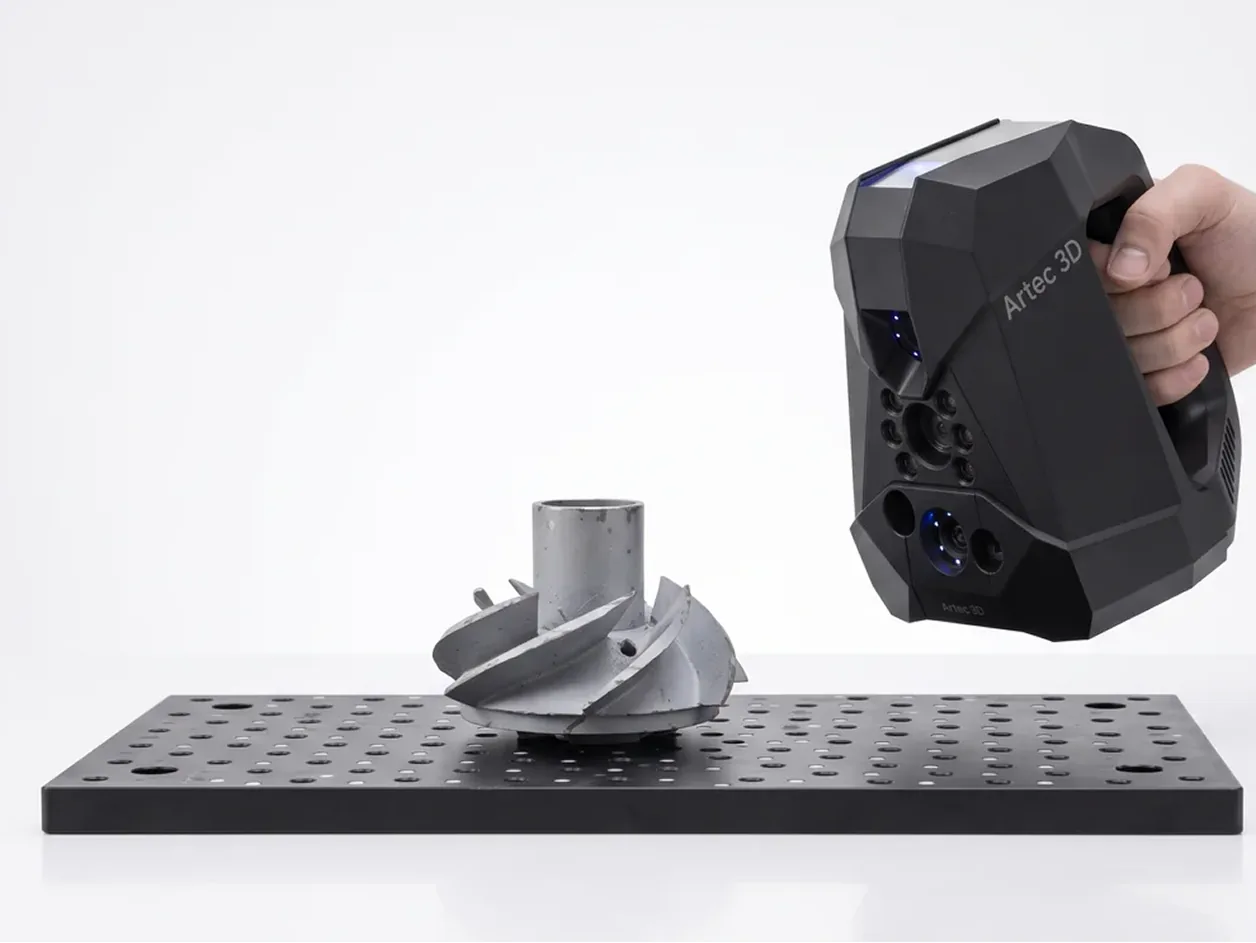
Hand holding the Artec Neo above a cast impeller on a perforated fixture table
Impeller passages are a typical spot where no target fits, so the Neo captures them target-free.

Hybrid scanning: targets only where tolerances matter

The Neo switches between target-based and target-free tracking inside a single scan. Place retroreflective targets on datums, seals and mating faces, where it reaches 0.025 mm, and let it track on geometry and texture everywhere else at 0.050 mm. You prepare far less of the part, and deep features such as impeller passages, where no target fits, are still captured. Targets can also go on the fixture instead, so finished surfaces stay clean.
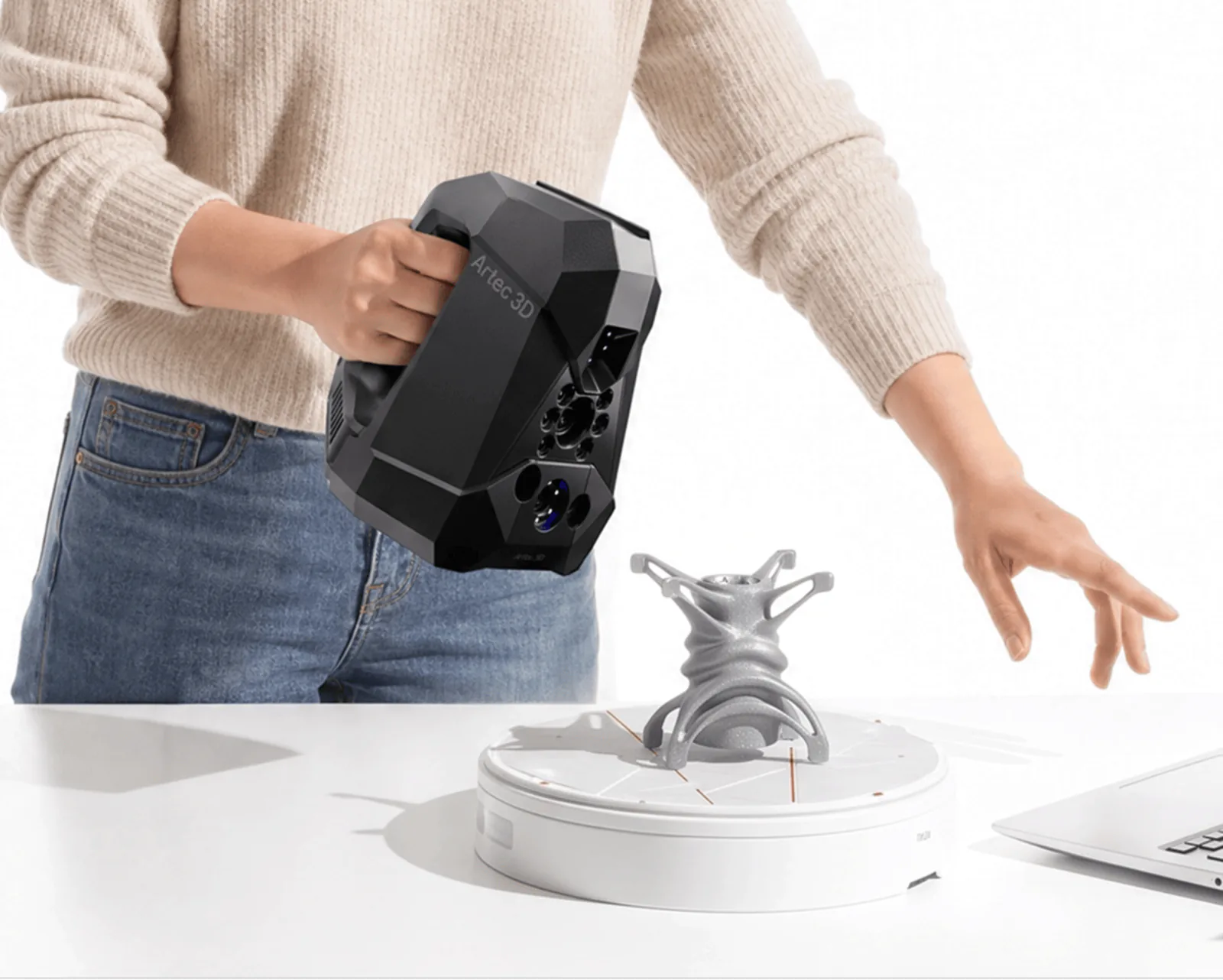
Person holding the Artec Neo over a grey lattice-shaped part on a white turntable, a laptop at the edge of the desk
On a small, intricate part like this one, the Neo records shape and color texture in the same pass.

Fast blue-light capture with color texture

Its 450 nm blue structured light captures up to 8 million points per second at a mesh resolution of 0.050 mm, so machined edges and fine surface detail come through in the raw data. A 5 MP camera records color at the same time. That texture documents part markings, wear and surface condition alongside the geometry, and it gives reverse engineering teams a clearer reference when they model.

Wireless 3D scanning on battery and Wi-Fi

The Neo carries its own batteries and talks to the computer over Wi-Fi, so you can walk around a large assembly or reach inside a machine without a cable snagging on the part. Back at the workstation, a Thunderbolt cable doubles the frame rate for detailed work. Where we can show it at your location, we run both modes on your own parts, so you see where each one fits your jobs.

  • Built-in batteries give 40 to 50 minutes of continuous scanning, and four batteries come with the scanner.
  • Wi-Fi works up to 6 m from a router, at up to 15 frames per second.
  • On a Thunderbolt cable the capture rate rises to 30 frames per second.
  • The scanner weighs 1.3 kg with its batteries in place.

What are the Artec Neo specifications?

Artec Neo specifications
Accuracy (with targets)0.025 mm
Volumetric accuracy (with targets)0.025 mm + 0.035 mm/m
Accuracy (without targets)0.050 mm
Volumetric accuracy (without targets)0.050 mm + 0.3 mm/m
Mesh resolution0.050 mm
Working distance0.19–0.3 m
Field of view (closest / furthest range)128 × 104 mm / 171 × 152 mm
Depth of field110 mm
Volume capture zone1,800 cm³
3D capture speedUp to 30 fps (15 fps over Wi-Fi)
Data acquisition speedUp to 8,000,000 points/s
Texture resolution5 MP, 24 bpp color
3D light source450 nm blue LED structured light
InterfaceThunderbolt 4 compatible, Wi-Fi
Wi-Fi rangeUp to 6 m with a router
Battery run time40–50 min continuous scanning
Acceptance testVDI/VDE 2634 Part 3, ISO/IEC 17025-accredited lab
Dimensions (H × D × W)187 × 156 × 118 mm
Weight1.3 kg with batteries
Supported OSWindows 11
Output formatsMesh: OBJ, PLY, WRL, STL, AOP, ASC, PTX, E57, XYZRGB; CAD: STEP, IGES, X_T; measurements: CSV, DXF, XML

Specs checked:

What is the Artec Neo used for?

  • First article inspection

    Cover the part with targets to hold 0.025 mm + 0.035 mm/m across the whole surface, then compare the mesh with CAD in Artec Studio.

  • Reverse engineering with toleranced features

    Target only the datums, fits and interfaces, and capture the rest of the part target-free with color, in one dataset.

  • Inspection without marking the part

    Put the targets on the fixture instead of the part, so critical surfaces stay clean while the setup carries the reference frame.

  • Assembly and installation checks

    Lay a trail of targets between connection points to measure flange-to-flange distances and bolt patterns several meters apart without scanning everything in between.

  • Deep channels and recesses

    Capture impeller passages, pockets and channels as they are, where targets cannot be applied, and compare them with CAD.

Industries

  • Automotive
  • Aerospace
  • Oil and gas
  • Manufacturing
  • Defense
  • Infrastructure

What surfaces and part sizes does the Artec Neo handle?

The Neo is rated for small to medium objects on Artec's size scale, roughly 5 to 50 cm, and the maker also cites parts from turbine blades up to vehicle bodies and aircraft panels several meters long when targets link the scan. Its working distance is 0.19 to 0.3 m, with a field of view from 128 × 104 mm up close to 171 × 152 mm at the far end. It captures deep channels, recesses and impeller passages where targets cannot go. Without targets it holds 0.050 mm + 0.3 mm/m over distance; with targets that tightens to 0.025 mm + 0.035 mm/m, so long parts call for targets.

Part size
50–500 mm
Positioning targets
Optional
Color texture
Captured
Wireless
Yes

Compare sizes, materials and finishes across every scanner

What software does the Artec Neo use?

The Neo runs in Artec Studio, the capture and processing software for every Artec scanner except the Jet, so teams that already own Artec hardware keep one workflow. Inside Artec Studio you can fit CAD primitives, cut 2D sections, auto-surface a mesh into CAD surfaces, and run mesh-to-CAD or mesh-to-mesh deviation maps. For deeper work, the maker lists hand-off to Geomagic Design X, Geomagic Control X, SOLIDWORKS and PolyWorks Inspector. Exports include OBJ, PLY, STL and E57 meshes, STEP, IGES and X_T CAD files, and CSV, DXF or XML measurements. Artec Twins can merge Neo data with long-range LiDAR scans for large scenes.

What comes with the Artec Neo?

The maker lists these items with the Artec Neo:

  • Artec Neo scanner
  • Four batteries
  • Set of Artec retroreflective targets
  • Individual accuracy certificate

How does the Artec Neo compare?

Can I see the Artec Neo scan my own work?

Often, yes. Tell us you want to see the Artec Neo, and we will confirm whether we can show it at your location. Where we can, we bring the scanner to your facility and scan what you choose, so you see how it handles your surfaces, sizes and tolerances before you decide, instead of judging from a spec sheet. Pick the job that is hardest to measure today, such as a part with no CAD model or a shape you cannot measure by hand, and say what you need to check. On-site demos are available in most areas; ask when you request.

  1. Request a demo, name the model and tell us what you want scanned.
  2. We confirm whether we can show that model at your location.
  3. Where we can, we scan your own work and review the data with you.

What do buyers ask about the Artec Neo?

Do I need targets to scan with the Artec Neo?

No. The Neo tracks geometry and texture on its own and reaches 0.050 mm accuracy without targets. Targets are needed for its best figures: 0.025 mm accuracy and 0.025 mm + 0.035 mm/m over distance. In hybrid mode you put targets only on the features that carry a tolerance, such as datums, seals and mating faces, and the scanner switches between tracking methods inside the same scan. Each unit comes with a set of Artec retroreflective targets, and the maker specifies accuracy using its own targets.

Is the Artec Neo fully wireless?

Yes. It has built-in batteries and Wi-Fi, so you can scan with no cable to the computer. The maker quotes 40 to 50 minutes of continuous scanning per battery set, includes four batteries, and gives a Wi-Fi range of up to 6 m from a router. Over Wi-Fi the capture rate is up to 15 frames per second; on a Thunderbolt cable at the workstation it rises to 30 frames per second.

How is the Artec Neo's accuracy verified?

Artec tests every Neo in its own metrology and calibration lab, which holds ISO/IEC 17025 accreditation from OLAS, Luxembourg's national accreditation body. The acceptance test follows VDI/VDE 2634 Part 3 and uses robot-driven scan paths with traceable reference objects, which takes operator skill out of the result. Each scanner ships with its own accuracy certificate, which helps when an inspection report must show traceability.

What computer does the Artec Neo need?

The maker lists Windows 11 as the supported system. The recommended setup is a 13th or 14th Gen Intel Core i7 or i9 processor with an NVIDIA RTX 4070 8 GB graphics card, and the minimum is a 12th Gen Intel Core i9 with an RTX 4060 8 GB. Plan the workstation before the scanner arrives, because hybrid scans with color texture put a heavy load on the graphics card.

Can the Artec Neo be combined with other Artec scanners?

Yes. Data from Artec handheld, desktop and long-range scanners can be merged in one Artec Studio project. The maker points to Neo with Leo as a strong pair: the Leo covers large surfaces quickly with its wider field of view, while the Neo captures the toleranced areas. For large sites, Artec Twins software can combine Neo scans with data from long-range LiDAR scanners.

See the Artec Neo scan your own work

Tell us what you want scanned, and we will confirm whether we can show it at your location. On-site demos are available in most areas. You can also start with a pricing request.

Call (816) 608-7745