Scanning technology and workflow
Laser vs structured-light 3D scanners: how they differ and which suits your work
Laser vs structured light 3D scanner: how each method measures, how they handle shiny parts, color and detail, and which Creaform and Artec models use each.
Key takeaways
- Both methods use triangulation: a light source and one or more cameras set at a known angle to each other.
- Laser scanners sweep sharp lines across the part; structured-light scanners project a pattern over a whole area at once.
- Creaform's HandySCAN and MetraSCAN lines and the Artec Point II use blue laser lines; the Artec Leo, Eva, Spider II and Neo and the Creaform Go!SCAN SPARK use structured light.
- The structured-light models in our catalog record color texture; the blue-laser HandySCAN line and the Point II record geometry only.
- Choose by part, surface, tolerance and job first. The light source usually follows from those answers.
Compare a few 3D scanner spec sheets and the split appears quickly: laser scanners on one side, structured-light scanners on the other. One camp talks about robustness on shiny metal, the other about speed, color and ease of use. Both make real measuring instruments, and both appear in our catalog, from the blue-laser Creaform HandySCAN BLACK Elite to the structured-light Artec Leo.
This guide explains how each method measures, where each has the edge and how to choose without getting lost in the marketing. The short version: settle the part and the job first, and the technology choice mostly follows.
In this article
How does a laser 3D scanner measure a part?
A laser scanner projects one or more sharp laser lines onto the part and watches them with cameras mounted at a known angle to the laser. Where the surface rises or falls, the line appears shifted in the camera image, and triangulation turns that shift into 3D coordinates. Handheld laser scanners project many lines at once and build the surface stroke by stroke as you move. Creaform's HandySCAN EVO Elite, for example, projects 46 blue laser lines plus a laser pointer, records up to 2,800,000 measurements per second and positions itself from targets on or around the part.
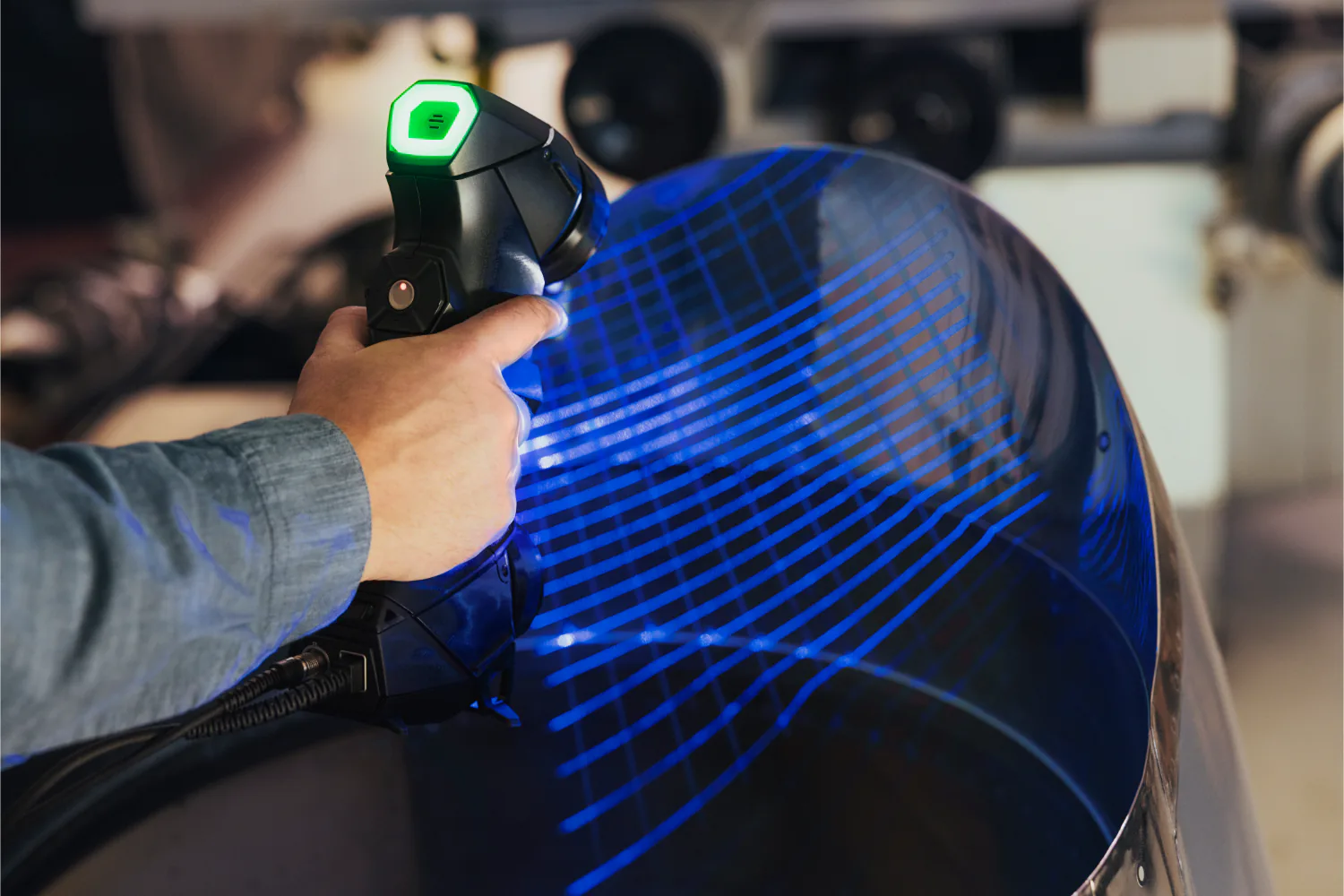
Blue lasers are now the norm on metrology-grade handhelds. A narrow, bright line stands out clearly in the camera image, which helps on finishes that confuse a broad pattern. The Artec Point II is a blue-laser scanner too, with three modes: an ultra-fast mode with 54 blue laser lines for broad surfaces, a hyper-fine mode with 17 parallel lines for small features, and a deep-hole mode with a single line for bores and grooves.
How does a structured-light 3D scanner work?
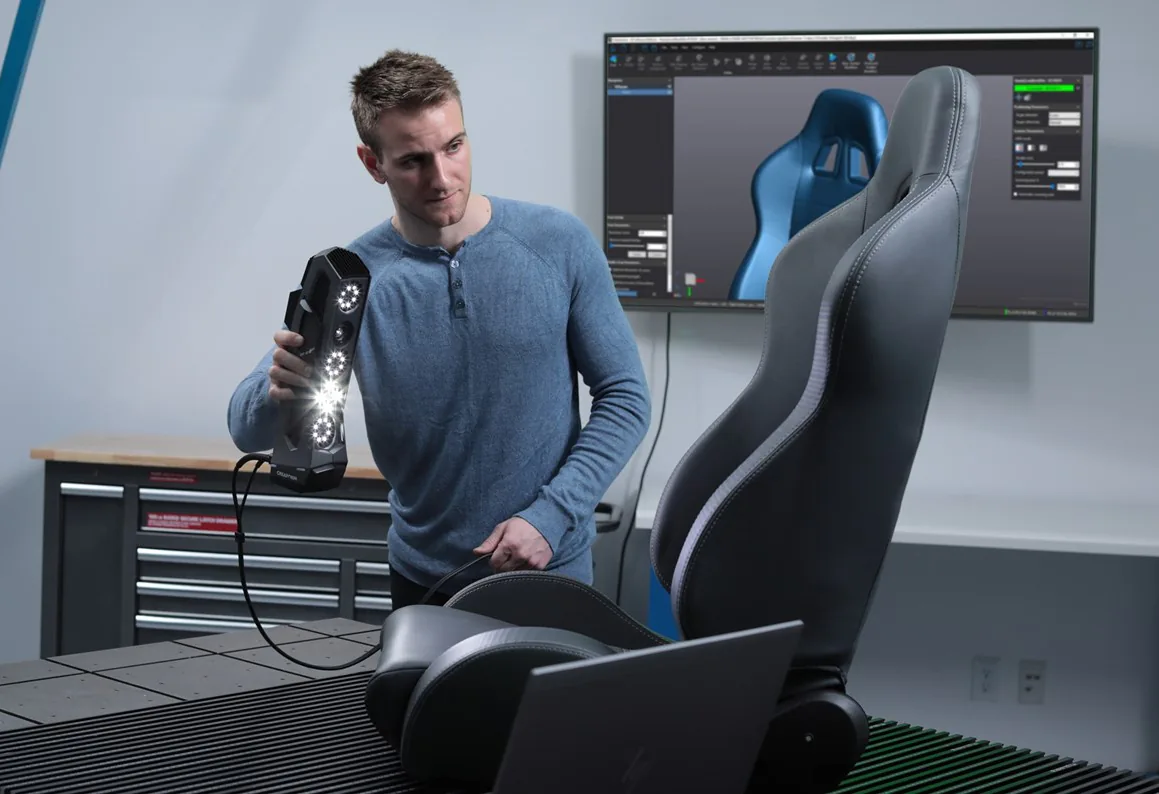
A structured-light scanner projects a known pattern across an area of the part, and its cameras read how that pattern bends over the surface. Each frame captures a whole patch at once rather than a set of lines, and the software fuses the frames as you move around the object. Many structured-light scanners track their position from the part's own shape and color, so targets are often unnecessary. The Artec Eva, Leo and Spider II work this way, and the Artec Neo uses 450 nm blue light and can scan with or without targets in the same session.
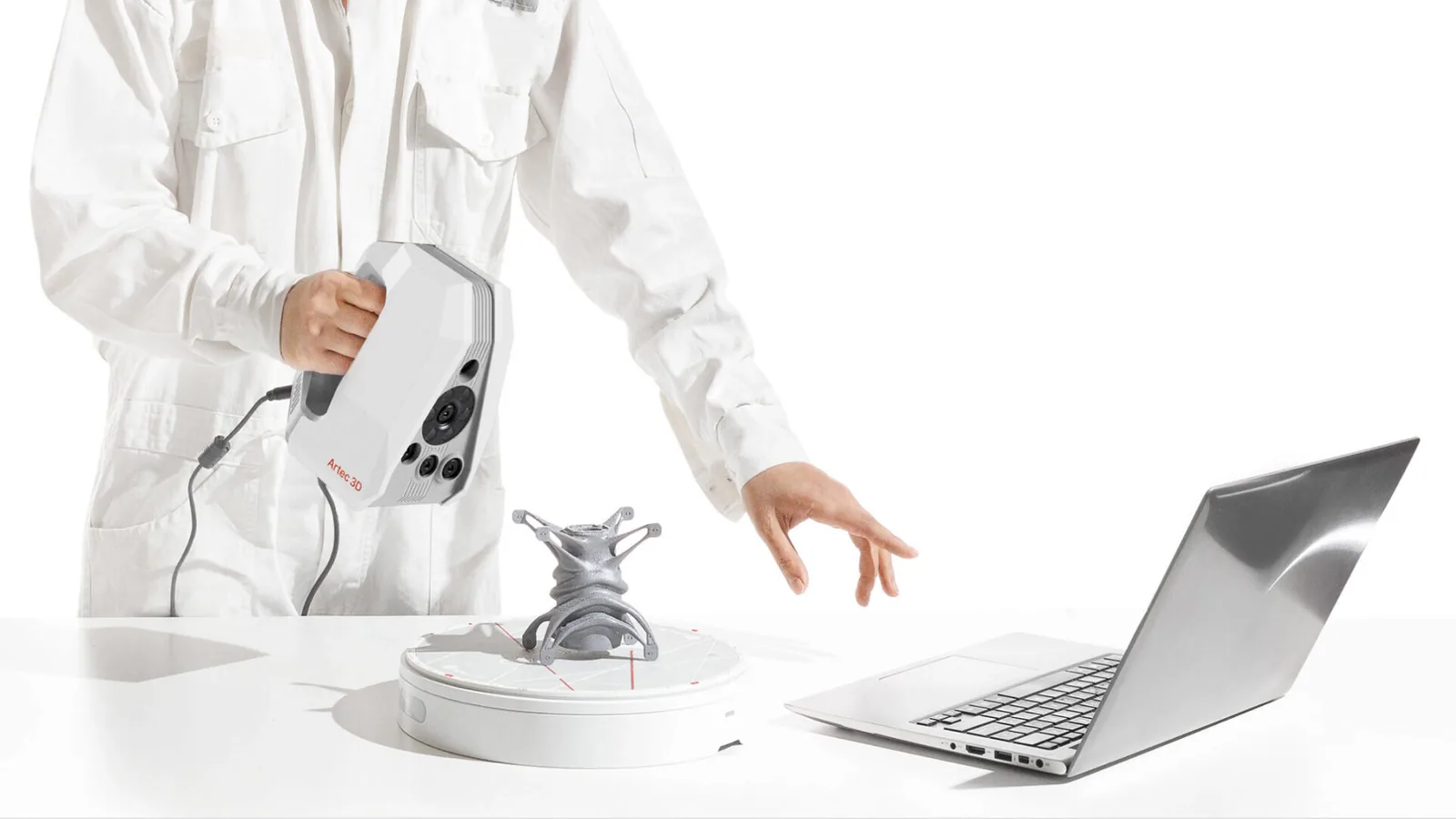
Because the cameras see a full image of the surface, the structured-light scanners we supply also record color. The Creaform Go!SCAN SPARK captures 24-bit color texture in the same pass as the geometry and can track on geometry, color texture or targets. The Artec Spider II pairs 0.05 mm resolution with 5 MP color texture, which suits small, intricate parts where both detail and appearance matter.
Laser and structured light at a glance
| Point of comparison | Laser line scanners | Structured-light scanners |
|---|---|---|
| How the light reaches the part | Sharp laser lines swept across the surface | A pattern projected over an area at once |
| How they position themselves | Targets on the part, or the C-Track tracker on the MetraSCAN | Shape and color of the part; targets optional on some models |
| Color texture | Not on the HandySCAN line or the Point II | Yes on the Leo, Eva, Spider II, Neo and Go!SCAN SPARK |
| Typical strengths | Metrology on shiny or dark metal, shop-floor work | Fast capture of organic shapes, color, little preparation |
| Models we supply | HandySCAN EVO, BLACK Elite, PRO and MAX EVO; MetraSCAN 3D; Artec Point II | Artec Leo, Eva, Spider II and Neo; Creaform Go!SCAN SPARK |
Read the table as tendencies, not rules. The Artec Neo is a structured-light scanner rated at 0.025 mm with targets, the same accuracy figure Creaform gives the laser-based HandySCAN BLACK Elite. The old idea that structured light is always the less accurate choice no longer holds across the board.
Which method copes better with shiny, dark and detailed parts?
Laser lines have long been the safer bet on shiny or dark metal, because a bright, narrow line stays visible where a projected pattern can wash out. Makers have narrowed the gap. Creaform states that its blue-laser scanners are engineered for shiny, dark and reflective materials, and Artec designed the Point II for black and reflective surfaces such as polished airfoils. On the structured-light side, Artec Studio offers automated sensitivity settings and an AI-based HD Mode for the Leo, Eva and Micro II on dark, shiny and finely detailed objects. For detail, compare resolution: 0.05 mm on the Spider II, up to 0.2 mm on the Leo and Eva in HD mode.
Transparent and mirror-finish parts are hard for every optical method, laser or pattern. Our guide to scanning shiny, dark and clear parts covers what to try first and when a removable coating is still the right answer.
What else should decide the choice?
The light source is one line on a longer list. Part size, tolerance, how the scanner tracks itself, whether you need color, the software path into your CAD and inspection tools, and who will do the scanning all carry as much weight. A team that measures large welded frames, a design studio that captures consumer products in color and a medical device maker fitting custom parts will each land on a different scanner, and the technology is a consequence of that choice rather than the starting point. Work through the list below before you compare light sources.
- Part size: most handhelds in our catalog cover parts up to about 4 m; for larger work, the HandySCAN MAX EVO Elite is rated for parts from 1 to 15 m.
- Tolerance: compare volumetric accuracy at your part length, which grows with size on every scanner.
- Tracking: decide whether placing targets fits your workflow or whether target-free capture matters more.
- Color: if appearance, documentation or medical fit matters, choose a model that records texture; our guide to scanners for people and medical work covers the medical side.
- Software: check how data reaches your CAD and inspection tools through Creaform.OS or Artec Studio.
- Operators: wireless models with a screen, such as the Leo, or the HandySCAN EVO with its on-scanner touchscreen, help occasional users.
Our Artec vs Creaform comparison sets the two brands side by side, and the scanner finder narrows the field to two or three models from a few questions about what you scan.
Choosing for your work rather than the technology
Most buyers who start with the laser-or-light question end up answering a different one: which two or three models handle their subjects, surfaces and tolerances. Once that shortlist exists, the light source is simply one fact on it. A reverse-engineering team working on cast housings may choose a HandySCAN PRO, a design team capturing consumer products in color may choose an Eva or a Go!SCAN SPARK, and a quality team measuring large weldments may choose a MetraSCAN.
Frequently asked questions
Is a laser 3D scanner more accurate than a structured-light scanner?
Not automatically. Accuracy depends on the model, not the light source. The structured-light Artec Neo is rated at 0.025 mm with targets, the same figure as the blue-laser HandySCAN BLACK Elite, while structured-light scanners built for speed and color, such as the Eva and Leo, are rated at up to 0.1 mm. Compare published figures and their test methods for the exact models you are considering.
Can a laser 3D scanner capture color?
The blue-laser scanners in our catalog, the HandySCAN line and the Artec Point II, record geometry without color texture. The HandySCAN EVO Plus and Elite add a 12 MP camera for photos linked to the 3D model; the Elite also shows deviation colormaps on the part. Neither gives you a textured mesh. For full color texture, look at the Go!SCAN SPARK, Leo, Eva, Spider II or Neo.
Do structured-light scanners need targets?
Often not. The Artec Eva, Leo and Spider II track their position from the shape and color of the object, so you can start scanning without preparation. The Go!SCAN SPARK can track on geometry, texture or targets. The Artec Neo works either way and reaches its best accuracy, 0.025 mm, when targets mark the toleranced areas. Large, smooth or featureless parts may still need a few targets.
Which technology is safe for scanning people?
Artec states that the Eva, which projects white structured light from a flash source rather than a laser, is safe for scanning people. That is one reason it is used for orthotics, prosthetics and custom medical fitting. Metrology laser scanners are built for parts and are rarely the right tool for scanning a person, and the Eva also records the color texture that helps when a fit depends on appearance.
Products in this article
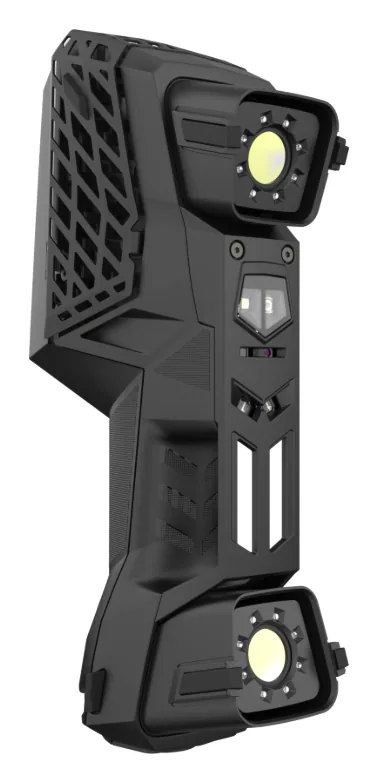 Creaform
HandySCAN EVO
Handheld metrology-grade blue-laser 3D scanner
0.020 mmBest accuracy
Creaform's flagship handheld laser scanner, with a touchscreen on the scanner, AR guidance on the EVO Plus and Elite, and a wireless option with the Mobility Kit.
- Part size
- 0.05–4 m
- Targets
- Required
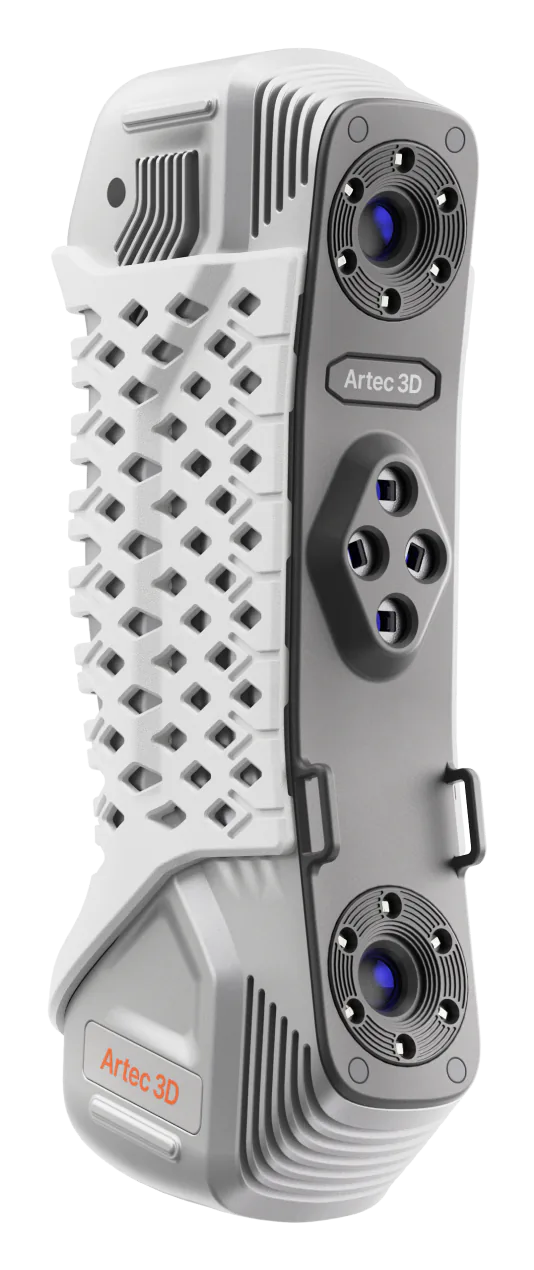 Artec
Point II
Handheld metrology-grade blue laser scanner
0.020 mmBest accuracy
A 570 g target-based blue laser scanner for metrology work on black, shiny and complex parts.
- Part size
- 0.05–2 m
- Targets
- Required
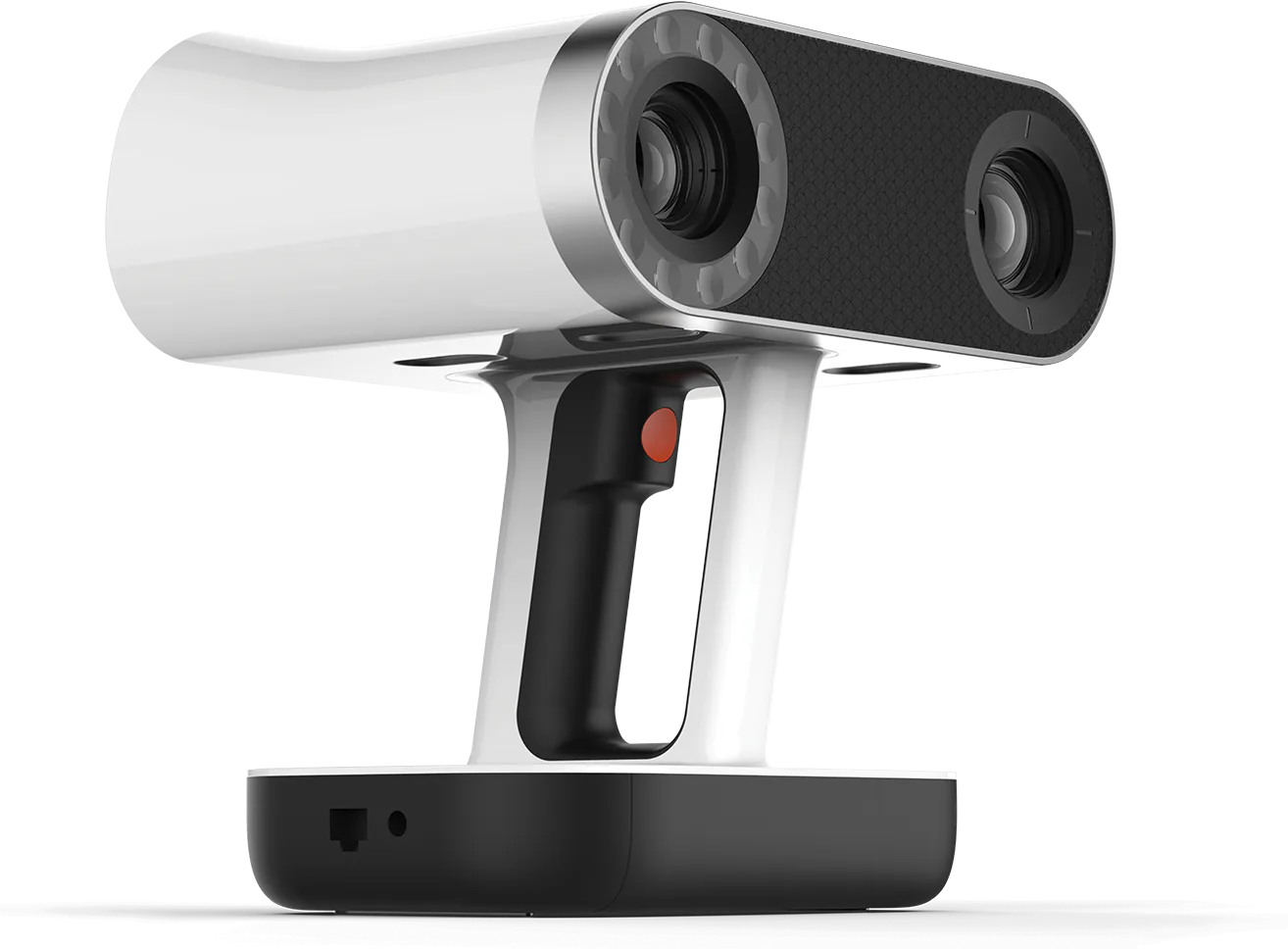 Artec
Leo
Wireless handheld 3D scanner with onboard processing
0.1 mmBest accuracy
A fully wireless scanner with its own screen, processor and battery for medium to large objects.
- Part size
- 0.2–2 m
- Targets
- Not needed
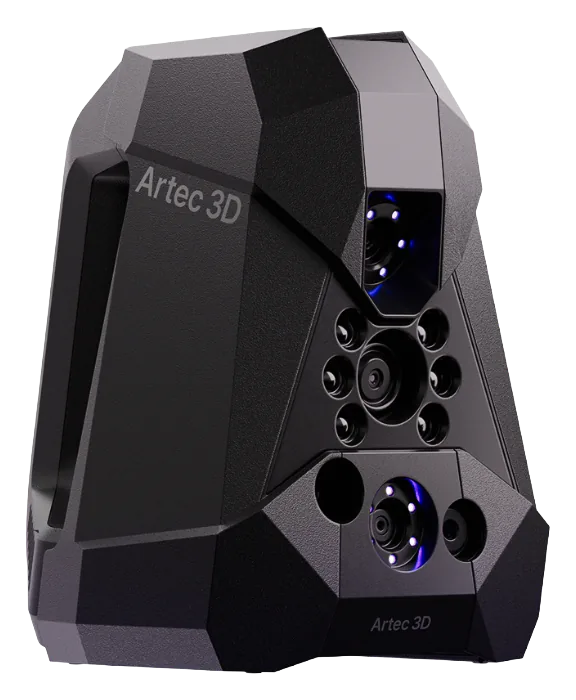 Artec
Neo
Wireless hybrid handheld metrology scanner
0.025 mmBest accuracy
A wireless handheld scanner that uses targets only where a tolerance must hold and scans target-free everywhere else.
- Part size
- 50–500 mm
- Targets
- Optional